Saturday, March 04, 2006

Thinning the Herd


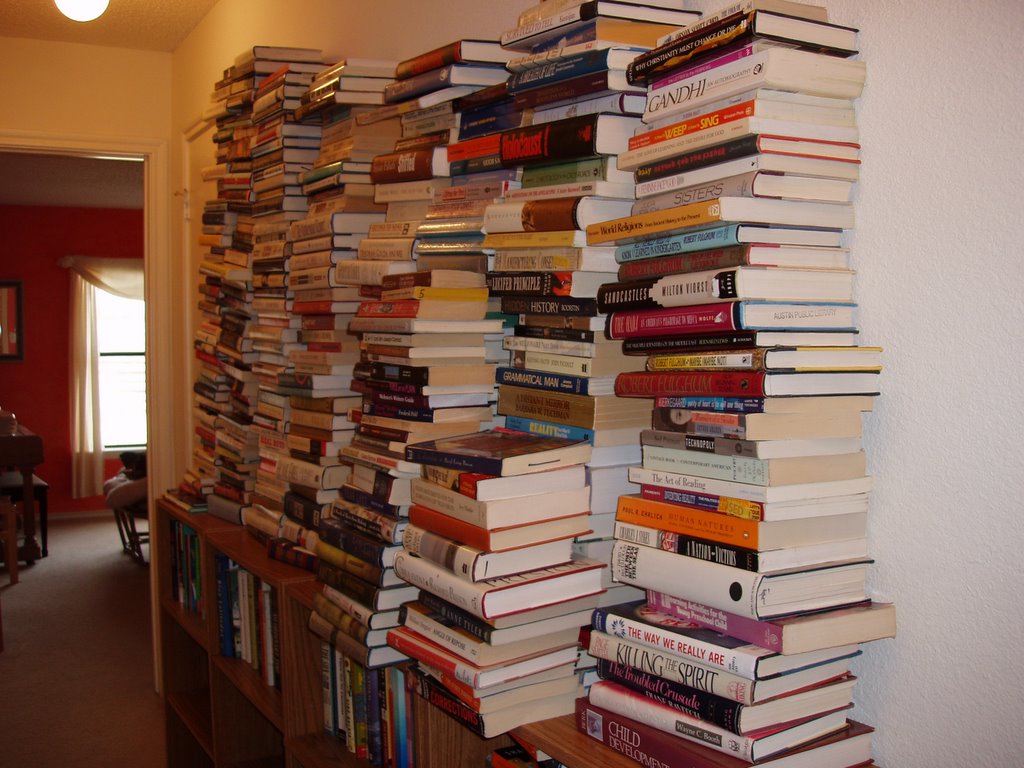
So I'm not sure what precisely happened, but in a moment last night, I went from a person who wouldn't think of parting with a book that I had read to someone who wanted nothing more than a drastic purging of any and every book that didn't justify its inch of shelf space. The picture is of all the books that are outta here. Here's a list of titles on their way out the door; some I've blogged on and some I haven't:

Can You Trust a Tomato in January?

Spoiled: Why Our Food Is Making Us Sick and What We Can Do about It

Why Does Popcorn Pop?

Beyond Beef: The Rise and Fall of the Cattle Culture

Secret Formula

Fat of the Land

Comfort Me with Apples: More Adventures at the Table

Culture of Complaint: The Fraying of America

Consumed: Why Americans Love, Hate, and Fear Food

How to Read a French Fry and Other Stories of Intriguing Kitchen Science

The Tummy Trilogy: American Fried, Alice, Let's Eat, and Third Helpings

Satisfaction Guaranteed: The Making of the American Mass Market

Pot on the Fire: Further Exploits of a Renegade Cook

The Last Days of Haute Cuisine: America's Culinary Revolution

The Clustered World: How We Live, What We Buy, and What It all Means about Who We are

Beard on Food

365 Good Reasons to Be a Vegetarian

Waste and Want: A Social History of Trash

Consuming Culture: Why You Eat What You Eat

Much Depends on Dinner

We Are What We Eat: Ethnic Food and the Making of Americans

Eat, Drink, and Be Merry

Never Satisfied: A Cultural History of Diets, Fantasies, and Fat

The Best Thing I Ever Tasted: The Secret of Food

The Greatest Generation

True Women

Kennedy

'Tis

Home Fires: An Intimate Portrait of One Middle-Class Family in Postwar America

Baghdad without a Map and Other Misadventures in Arabia

A History of Reading

The Book on the Bookshelf

A Place for Us: Eleni's Children in America

Cane River

Real Boys: Rescuing Our Sons from the Myths of Boyhood

Amazing Grace: The Lives of Children and the Conscience of a Nation

Rethinking Schools: An Agenda for Change

Ghosts from the Nursery: Tracing the Roots of Violence

Punished by Rewards

The Trouble with Perfect

New Mother's Guide to Breastfeeding

Minding the Children: Child Care in America from Colonial Times to the Present

Battleground: One Mother's Crusade, The Religious Right, and the Struggle for Our Schools

Childwise

The Shelter of Each Other

Saving Childhood: Protecting our Children from the National Assault on Innocence

Failure to Connect: How Computers Affect Our Children's Minds--and What We Can Do about It

The Closing of the American Mind

Marriage and Family in a Changing Society

There Are No Children Here: The Story of Two Boys Growing Up in the Other America

Child Development

The Vocation of a Teacher

The Troubled Crusade: American Education 1945-1980

Killing the Spirit: Higher Education in America

The Way We Really Are: Coming to Terms with America's Changing Families

Learning Activities for the Young Preschool Child

The Path Between the Seas

The Fatal Shore: The Epic of Australia's Founding

Reading Lolita in Tehran: A Memoir in Books

A Renaissance Tapestry: The Gonzaga of Mantua

The Kindness of Strangers: The Abandonement of Children in Western Europe

Prodigal Summer

Traveling Mercies: Some Thoughts on Faith

Not All of Us Are Saints: A Doctor's Journey with the Poor

The African Experience

Lost Worlds: How Our European Ancestors Coped with Everyday Life and Why Life Is So Hard Today

A Geography of Time: The Temporal Misadventures of a Social Psychologist

Levitating Trains and Kamikaze Genes

Living Out Loud

A Not Entirely Beniegn Procedure: Four Years As a Medical Student

Good Wives: Image and Reality iin the Lives of Women in Northern New England, 1650-1750

Wide Awake at 3:00am: By Choice or By Chance?

The Concise Dictionary of English Etymology

A Map of the World

The Lexus and the Olive Tree

365 TV-Free Activities You Can Do With Your Child

365 Outdoor Activities You Can Do With Your Child

The Twentieth Century: The History of the World: 1901 to 2000

A Civil Action

A Woman in Residence: A Doctor's Personal and Professional Battle Against An Insensitive Medical System

Operating Instructions: A Journal of My Son's First Year

Rubbish: The Archaeology of Garbage

September

The Act of Reading: A Theory of Aesthetic Response

The Vintage Book of Contemporary American Poetry

Technopoly: The Surrender of Culture to Technology

Memoirs of a Geisha

Inventing Reality: The Politics of News Media

Purity of the Heart Is to Will One Thing

How Does Aspirin Find a Headache?

Extraordinary Popular Delusions and the Madness of Crowds

The Pilot's Wife

Manufacturing Victims

Villages

The Mother Tongue: English and How It Got That Way

Homeward Bound: American Families in the Cold War Era

A Nation of Victims: The Decay of the American Character

Human Natures: Genes; Cultures, and the Human Prospect

In Love with Norma Loquendi

The Girl from Botany Bay

Christmas Portraits

The Bible Code

When I Am an Old Woman I Shall Wear Purplse

An Introduction to Language

Low Fat Cooking

Chicken Soup for the Mother's Soul

Reality Isn't What It Used to Be

A Distant Mirror

Grammatical Man

Keeping Faith

The Millionare Next Door

The Professor and the Madman

The Girl with the Pearl Earring

Hidden History: Exploring Our Secret Past

The Lucifer Principle: A Scientific Expedition into the Forces of History

Manufacturing Consent: The Political Economy of the Mass Media

The Heath Anthology of American Literature

The Seven Storey Mountain

The View from a Monestary

The Inquisition: Hammer of Heresy

Why God Became Man and The Virgin Conception and Original Sin

The Birth of Christianity: Reality and Myth

The Cloister Walk

Christology in Dialogue

The Gospel of Mark

A World Full of Gods: The Strange Triumph of Christianity

The Way of Jesus Christ

Jesus, the Crucified People

Catch-22

The Lion, the Witch, and the Wardrobe

The Gay Science with a Prelude in Rhymes

Les Miserables

King Lear

Plagues and People

The Color Purple

Fried Green Tomatoes at the Whistle-Stop Cafe

A Woman's Journey to God

The Bad Popes

Jesus in Contemporary Scholarship

Why Christianity Must Change or Die

Dictionary of Saints

Christology at the Crossroads

Meditations on the Apocalype

The Letter to the Hebrews

Crossing the Threshhold of Hope

Everyday Life in Ancient Times

The Holocaust

A Breath of Life: Feminism in the American Jewish Community

Jewish Memories

Tradition in A Rootless World: Women Turn to Orthodox Judaism

The Folk of the Fringe

Gandhi: An Autobiography

Medieval Women's Visionary Literature

Communion: Contemporary Writers Reveal the Bible in Their Lives

In Whose Image? God and Gender

A Time to Weep, A Time to Sing: Faith Journies of Women Scholars of Religion

The Love of Learning and the Desire for God: A Study of Monastic Culture

Sisters: Lives of Devotion and Defiance

The Feminine Face of God: The Unfolding of the Sacred in Women

Beyond God the Father: Toward a Philosophy of Women's Liberation

It Was on Fire When I Lay Down on It

All I Really Needed to Know I Learned in Kindergarten

World Religions from Ancient History to the Present

Sandcastles: The Arabs In Search of the Modern World

Hadj: An American's Pilgrimage to Mecca

The Multiple Identities of the Middle East

Maybe (Maybe Not)

From Beginning to End: The Rituals of Our Lives

The Second Stage

Stiffed: The Betrayal of the American Man

Fire with Fire: The New Female Power and How It Will Change the 21st Century

Second to None: A Documentary History of American Women

A History of Their Own: Women In Europe

Deborah, Golda, and Me: Being Female and Jewish in America

Generations: A Century of Women Speak about Their Lives

Home-Alone America: The Hidden Tole of Day Care, Behavorial Drugs, and Other Parent Substitutes

The Women's Room

Women and Men in Society

Issues in Feminism: An Introduction to Women's Studies

Women of Ideas (and What Men Have Done to Them)

The World Split Open: How the Modern Women's Movement Changed America

Women's Roots

The Women's History of the World

Lifting the Veil: The Feminine Face of Science

Women of the Four Winds: The Adventures of Four of America's First Women Explorers

The Underside of History Volume I

The Underside of History Volume II

Gyn/Ecology: The Metaethics of Radical Feminism

The Mismeasure of Woman: Why Women Are Not the Better Sex, the Inferior Sex, or the Opposite Sex

Sex, Art, and American Culture

The Psychology of Women

Women at Work

Woman's Creation: Sexual Evolution and the Shaping of Society

Women of the Forest

Brave New Families: Stories of Domestic Upheaval in late 20C America

Misdiagnosis: Woman As A Disease

The Mask of Motherhood: How Becoming a Mother Changes Our Lives and Why We Never Talk about It

A Life's Work: On Becoming a Mother

American Mom: Motherhood, Politics, and Humble Pie

Food and Whine: Confessions of an End of the Millennium Mom

Fruitful: A Real Mother in the Modern World

Mothers Talking: Sharing the Secret

Spin Sisters: How the Women of the Media Sell Unhappiness--and Liberalism--the the Women of America

The War Against Boys: How Misguided Feminism is Harming Our Young Men

Ever Since Adam and Eve

Misconceptions: Truth, Lies, and the Unexpected on the Journey to Motherhood

What's a Smart Woman Like You Doing at Home?

Mother Journeys: Feminist Write about Mothering

Ever Since Eve: Personal Reflections on Childbirth

The American Way of Birth

Mothers and Such: Views of American Women and Why They Changed

The Motherhood Report: How Women Feel about Being Mothers

The Price of Motherhood: Why the Most Important Job in the World Is Still the Least Valued

Good Enough Mother: Changing Expectations for Ourselves

Margaret Sanger and the American Birth Control Movement

Sam Walton: Made in America

The Girl from Purple Mountain: Love, Honor, War, and One Family's Journey from China to America

Waiting: True Confessions of a Waitress

Lady Bird: A Biography of Mrs. Johnson

Blue Sky Dream: A Memoir of America's Fall from Grace

21 Dog Years: Doing Time at Amazon.com

Not by the Sword: How the Love of a Cantor and His Family Transformed a Klansman

M.D.: One Doctor's Adventures Among the Famour and Infamous from the Jungles of Panama to a Park Avenue Practice

Founding Mothers: The Women Who Raised Our Nation

Straight from the Heart: My Life in Politics and Other Places (Ann Richards)

A Reporter's Life (Walter Cronkite)

Not Without My Daughter: A True Story

Princess: A True Story of Life Behind the Veil in Saudi Arabia

Zoya's Story: An Afghan Woman's Struggle for Freedom

My Forbidden Face: Growing Up Under the Taliban: A Young Woman's Story

A Bomb in the Brain: A Heroic Tale of Science, Surgery, and Survival

Trial by Fire: A Woman Correspondent's Journey to the Frontline

A Girl Named Zippy: Growing Up Small in Mooreland, Indiana

The Dark Side of Camelot

Washington: The Indispensible Man

Mornings on Horseback

A Hope in the Unseen: An American Odyssey from the Inner City to the Ivy League

Seven from Heaven: The Miracle of the McCaughy Septuplets

Galileo's Daugher: A Historical Memoir of Science, Faith, and Love

Abraham Lincoln

The Hungry Ocean: A Swordboat Captain's Journey

Great Harry

Her Little Majesty: The Life of Queen Victoria

Lilibet: An Intimate Portrait of Elizabeth II

Storytelling with the Flannel Board

Ronald Reagan: An American Life

House of Sand and Fog

A Walk in the Woods

The Birth of Venus

The Known World

The Emperor of Scent

A Crack in the Edge of the World: America and the Great California Earthquake of 1906

What Einstein Told His Cook Volume II

Plain Speaking: A Candid and Revealing Portrait of the 33rd President in His Own Voice

Mary Queen of Scotland and the Isles

Food Fight: The Inside Story of the Food Industry, America's Obesity Crisis, and What We Can Do about It

From Sundails to Atomic Clocks

One Hundred Days: My Unexpected Journey from Doctor to Patient

Ether Day: The Strange Tale of America's Greatest Medical Discovery and the Haunted Men Who Made It

The Measure of All Things: The Seven-Year Odyssey and Hidden Error That Transformed the World

Entwined Lives: Twins and What They Tell Us About Human Behavior

A Natural History of the Senses

In a House of Dreams and Glass: Becoming a Psychiatrist

The God Particle: If the Universe Is the Answer: What Is the Question?

The Mind of God: The Scientific Basis for a Rational World

Dreams of a Final Theory: The Search for the Fundamental Laws of Nature

The Medicine of ER or How We Almost Die

The Physics of Star Trek

The Secret Life of Germs: Observations and Lessons from a Microbe Hunter

How We Die: Reflections on Life's Final Chapter

First, Do No Harm: The Dramatic Story of Real Doctors and Patients Making Impossible Choices at a Big-City Hospital

Why We Get Sick: The New Theory of Darwinian Medicine

The Copernican Revolution: Planetary Astronomy and the Development of Western Thought

Why Things Bite Back: Technology and the Revenge of Unintended Consequences

The Stone Age Present: How Evolution Shapes Modern Life

Paradigms Lost: Images of Man in the Mirror of Science

Exploding the Gene Myth

Leprosy: Diagnosis and Management

Discoveries and Opinions of Galileo

Doctors: The Biography of Medicine

Nobel Prize Women in Science

The First Three Minutes: A Modern View of the Origin of the Universe

Myths, Models, and Paradigms

The Birth of a New Physics

Medicine at the Crossroads

The Selfish Gene

The Construction of Modern Science

The Cosmic Blueprint

The Scientific Background to Modern Philosophy

The Medical Detectives

Empires of Time: Calendars, Clocks, and Culture

Fuzzy Thinking: The New Science of Fuzzy Logic

Virus X: Tracking the New Killer Plague

The Brethren

The Lazarus Child

The Nanny Diaries

The Bonesetter's Daughter

Drowning Ruth

The Voyage of the Narwhal

The Corrections

The Stone Diaries

Bridget Jones' Diary

The Curious Incidnet of the Dog in the Nighttime

Angle of Repose

Back When We Were Grownups

A Perfect Arrangement

The Cobra Event

Paper Trail

Seeing Calvin Coolidge in a Dream

Little Altars Everywhere

Midwives

Holidays in Hell

Parliament of Whores

Age and Guile Beat Youth, Innocence, and a Bad Haircut

Give War a Chance

Slaves in the Family

Shadows and Wind: A View of Modern Vietnam

The Lost Tribe: A Harrowing Passage Into New Guinea's Heart of Darkness

Family Man

Faster: The Acceleration of Just About Everything

Never Done: A History of American Housework

Out of Silence: A Journey into Language

The Search for the Perfect Language

Middletown, America: One Town's Passage from Trauma to Hope

The Middle of Everywhere: Helping Refugees Enter the American Community

Bias: A CBS Insider Exposes How the Media Distort the News

I Want That! How We All Became Shoppers

The Myth of the Welfare Queen

Why We Buy: The Science of Shupping

Feasting the Heart: 52 Commentaries for the Air

Alpha Beta: How 26 Letters Shaped the Western World

A World of Their Own Making: Myth, Ritual, and the Quest for Family Values

Fearless: Real Truth about Risk, Safety, and Security in a Time of Terrorism

The 9/11 Commission Report

Four Arguments for the Elimination of Television

Around the Bloc: My Life in Moscow, Beijing, and Havana

The Rest of Us: Dispatches from the Mother Ship

Calendar: Humanity's Struggle to Determine a True and Accurate Year

Walden

The Great Gatsby

Of Mice and Men and Cannery Row

The Grapes of Wrath

East of Eden

I Know Why the Caged Bird Sings

Roots

Surely You're Joking, Mr. Feynman!

The Physics of Star Trek

The Ships of Earth

Cultural Anthropology

The Changling

Survived to Tell: An Autobiography

Sunday, February 26, 2006

Stand As a Witness: The Biography of Ardeth Greene Kapp

Book Cover


We begin with a quiz: How many book-length biographies of LDS women can you name?
.
.
.

Wednesday, February 22, 2006

The Salt Lake City 14th Ward Album Quilt

In the 1990s, Carol Nielson inherited a quilt. Or, to be more precise, half a quilt.

Her words on that occasion came by instinct: "Only a man could do that." She was right; her husband's great-great grandfather had cut the quilt down the middle rather than slight one of his daughters. Intrigued by the quilt, Nielson took advantage of the fact that each block contained the name of its creator and eventually wrote a book consisting of mini-biographies of each woman. At this point, gentle reader, you are perhaps tempted to adopt that glazed expression the Saints share when someone's sacrament meeting talk on family history shifts into a reminiscence of their family history. There's nothing more boring than someone else's family history, is there?

But this book deserves more than glazed stares: not only are the women from some of the pioneer families that you know best (Woodruff, Young, Richardson; the 14th Ward included Temple Square and was home to many Church leaders), but their lives in 1857 give a snapshot of the Church, with converts from the four corners gathered to Utah--living The Principle. Polygamy is a major issue in this book; virtually every quilter shared her husband.

Which brings us to the major weakness of this work: Nielson is not a historian. A schoolteacher by trade, she approaches difficult interpretive issues such as polygamy in a rather naive way. In a brief explanation in the introduction, she states that the Church practiced polygamy simply in order to "raise up seed." (Considering Joseph Smith's polyandry, this is hardly a compelling argument.) Her rosy approach to polygamy is never more obvious than when she writes about sister wives who shared the burden of entertaining church and government leaders: "a formidable task that would make any woman wish for a sister wife." (I'd probably be content to hire a caterer.) At one point, in what one can only hope was an unreflective moment, she refers to polygamy as the "higher law."

Further, Nielson's prose is often wooden, occasionally clunky, and sometimes even confusing. She frequently fumbles by attempting to find some metaphor for the woman's life in her quilt square ("The . . . severed block, with the first and last names separated, lucklessly served as a portent of the future. Matilda's tenure as wife of Isaac Rhoads was short.")

Yet the book is still worthwhile for the glimmers that emerge of lives barely included in most historical records. They range from six-year-old Bulah Woodruff (whose father, Wilford Woodruff, would later write that she was "on the road to destruction" in a classic example of the ability of historical sources to hide more than they reveal and to tease the modern reader beyond that which she is able to bear) to Josephine Richards (a 'countess' who, after reading Les Miserables, sent a letter to Victor Hugo suggesting that the Gospel was the cure for the ills of which he wrote) to Deborah Turnbow (who buried ten of her thirteen children). There's also interesting historical trivia here; most Saints are probably not aware, for example, that independent Relief Societies existed in the period after Nauvoo and before their formal church-wide reorganization in 1867. The lived reality of polygamy (the devil is in the details) is also a source for interesting factoids: "For subsequent wives, the title 'Mrs.' customarily preceded their own name," while only the first wife would use her husband's first name after the 'Mrs.' I did not know--until I read of the experience of quilter Mary S. Snow--that on one occasion (which Nielson calls "not an isolated incident"), a woman's sister wife was none other than her own mother.

Nielson notes that two incidents crystalized her commitment to writing this book: she had a photo labelled with the man's name and "and wife." Since he was polygamous, she didn't know which wife was in the photo. She contacted one of the man's descendents for help. He didn't know but he attempted to reassure her: "Women weren't important back then, you know. It really doesn't matter which wife it is." Later, she was thrilled to find a good-sized biography of one of the quilter's husbands. Imagine her dismay when she flipped through it and found this: "Unfortunately, there is not space to go into the history of the wives, nor their courage, patience, and other excellent qualities."

It is that type of thinking which explains why, despite its flaws, I'm grateful that Nielson did "go into" the history of the women who created this quilt. The brief biographies, evocative photos of the women, and large reproductions of each quilt square--all on heavy paper, with the quilt photos in full color--make this book a fitting testament to those pioneer women who devoted their talents (and their precious fabric) to relieving the needs of others.

Cross posted to Times & Seasons

Daughters of Light by Carol Lynn Pearson

This slender compilation of anecdotes is designed to chronicle the exercise of gifts of the spirit--by women. Chapters are devoted to the gift of tongues, prophecy, revelation, healing and power over evil spirits. It was, apparently, another fruit of the years that Leonard Arrington was in charge of the Church Archives.

Friday, February 17, 2006

The Girl from Botany Bay by Carolly Erickson

Mary Bryant was born into a poor family in England. She became a 'highwaywoman,' was sentenced to death, was given a reprieve and sent to Australia with the first batch of convicts, married and had two children, escaped to Timor in a 25-foot boat, was caught, saw both children die, was sent back to England to be punished, caught the fancy of the nation and Samuel Johnson, was given a reprieve, and promptly disappeared from the historical record. Wow.

Sunday, February 12, 2006

In Sacred Lonliness: The Plural Wives of Joseph Smith by Todd Compton

This is almost two separate books:

(1) Mini-biographies of the almost three dozen women who were married to Joseph Smith. On this level, it is a fascinating read--full of the trials, daily life, and amazing faith of these early LDS women.

(2) An interpretation of early LDS polygamy. This section was more of a mixed bag for me. I think that Compton's idea of these marriages as 'dynastic' probably makes sense; but I also think that his condemnation of polygamy as institutional neglect is a little overdone since not a one of these women experiences what we might call 'normal' LDS polygamy: married to Joseph Smith and then, usually, either Brigham Young or Heber C. Kimball after the martyrdom, they did not experience what most polygamous wives did.

This is, nonetheless, one of the most important texts for understanding early Mormonism.

Under the Banner of Heaven

I have a friend –I know her through the homeschooling community–with an interest in the Church. She told me that one of the books that she read about the church was Under the Banner of Heaven: A Story of Violent Faith. Now, she’s not stupid–she didn’t expect it to be unbiased–but she did want to know my reaction to it. So I read it and then sent her this email:

Hi xxxxxxxxx,

I read Under the Banner of Heaven this weekend, and I think my reaction to it is probably about what your reaction would be to a book that argued that homeschooling should be illegal on the basis of a few abusive families who hid their abuse by claiming to homeschool.

I was really amazed at how fast and loose Krakauer was with the evidence. I could give you literally dozens of examples, but I doubt you want to read all that, so let me just pick a few:

(1) His entire explanation for Joseph Smith’s polygamy is that it was about fulfilling his sexual lust with what Krakauer calls ‘nubile adolescents.’ This thesis becomes a little less convincing when you know the ages of some of the women that he married: 47, 50/51, 53/54, 58, and 56 (while Joseph Smith was in his 30s).

(2) His basic thesis is that religious belief in general–and LDS belief in particular–causes people to be violent because rationality goes out the window when people think they can talk to God. This is a fairly easy thesis to prove or disprove–about all it takes is a quick look at the statistics to see if areas with high LDS populations have a higher or lower violent crime rate than the national average. Utah County is often used for this type of thing since it has about a 90% LDS population: “An FBI report showed the Provo-Orem area to have the second-lowest rate of violent crime in the nation for the year 2000.” Of course, Krakauer doesn’t mention this but instead focuses on a few lurid and sensational cases–as if there were a single minority group (racial, religious, lifestyle, whatever) that couldn’t be painted as a hothouse for violence on the basis of a few of its members.

(3) He writes about a revelation John Taylor had in 1886 that stated that polygamy would never be ended and that some church members would be called to be ostracized by the church for practicing polygamy. What he doesn’t mention in the text is that his only source for these revelations is . . . a book printed by the FLDS Church! But in the text, he makes it sound as if the revelations are only disputed by a few angry LDS leaders when, in fact, no historian would uncritically accept these as a historical source given their attestation.

(4) He pins the blame for the Mountains Meadow Massacre cleanly on Brigham Young, despite the fact that one of his own main source for that chapter [Juanita Brooks] wrote, “The complete—the absolute—truth of the affair can probably never be evaluated by any human being; attempts to understand the forces which culminated in it and those which were set into motion by it are all very inadequate at best” (Brooks, p. 223).

(4) He often seemed to confuse the doctrine and practice of the LDS and FLDS churches; whether this was deliberate, sloppy writing, or based on his own ignorance of the differences, I can’t say. There are many false statements in the book, such as that the LDS church strongly discourages marriage between black and white members which is completely false. (In fact, a respected couple in my own congregation is an interracial couple.) Another one is that members–particularly women–are encouraged to be mindless sheep. But his own example of Brenda Lafferty as a headstrong woman who wouldn’t tolerate any nonsense suggests otherwise.

I could go on with similar examples from virtually every page, but I think you’ve gotten the feel for my response to this book. I hope that if it raised any specific questions for you, you’ll ask me.

Julie

Note: Lest you think that it is only one quirky woman using this book as a primer on Mormonism, go do a search on Amazon using the keyword ‘Mormon.’ This book is the bestselling book under that keyword. Ugh. Those interested in a more thorough response than mine should read this.


Cross posted from Times & Seasons.

Thursday, February 02, 2006

Mao: The Unknown Story by Jung Chang

Wow. Mao makes Hitler look like a grade-school bully. Wow. While this book doesn't psychologize Mao much, it was interesting to watch his unremitting focus on personal power and his complete disregard for human life play out against the fates of the 70 million people who he killed. Wow. It is fascinating to watch a character assissination against someone who deserves it.

Saturday, January 07, 2006

Light from Heaven by Jan Karon

Is there a word for books that are like comfort food? That's what Karon's books are, and they fulfill the purpose of their creation.

Thursday, December 29, 2005

Hungry Planet by Peter Menzel

This is easily one of the ten most interesting books that I have ever read; Menzel went to thirty families around the world and asked them to buy a week's worth of food and then photographed it. Simple and amazing.

Thursday, December 22, 2005

David O. McKay: Around the World by Hugh J. Cannon

Every writer's worst nightmare actually came true for Hugh J. Cannon: the only copy of his manuscript was "misplaced" by the publisher.

And it wasn't just any manuscript either: it was the record of his 1920 round-the-world trip with David O. McKay (then a member of the Quorum of the Twelve), on assignment from the First Presidency as "special missionaries" to visit all of the missions and Church schools. The manuscript turned up recently and has now been published. This book is somewhat sketchy about its history, tersely attributing its disappearance to "a change of personnel at the publisher" and giving no more detail about its recovery than that it was found in the McKay home. One almost suspects that there is more to the story.

That would become a frequent impression while reading this book: that I wasn't getting the whole story. McKay and Cannon were on assignment to assess the missions but virtually nothing is said about those missions in this book, save that the missionaries were virtuous and brave. We know from other works on McKay that this isn't all that they found (see here for a reference in Woodger's biography to some of the problems that McKay found in Tahiti). So if you approach this book looking for Church history or doctrine, you will almost certainly be disappointed.

However, if what you want is a good story, well-told in the quaint, wry style of a superior early-twentieth-century wordsmith, you will be delighted. Let me give you a taste of Cannon's writing:

Numerous invitations to dinners and other social affairs where refreshments were served were extended to the special missionaries during the weeks immediately preceeding their departure. Such acts, intended as kindness and greatly appreciated, were poor preparation for a rough ocean voyage. Some of these delightful dinners were destined to come up later in a most distressing manner. Have you ever been aboard a vessel on an extremely rough sea? Have you felt it roll and toss and plunge, then when struck full force by a mighty wave which washes its decks, felt it shudder and tremble as though it had received a death blow and must assuredly sink? And all the while the stomachs of the sensitive passengers are performing similar evolutions and are dancing about as wildly as the ship itself. Frequently not more than a dozen people out of several hundred passengers were at meals. . . . Brother McKay, being the leader of this tour, maintained his supremacy in the matter of seasickness as in all other things. He does nothing by halves, but treats every subject exhaustively, going to the very bottom of it, and this occasion was no exception. Seasickness is undertaken with the same vigorous energy which he displays in running for a train. In either case those in front should dodge.


Seasickness becomes a recurrent theme in this book; they did, after all, travel 37,869 miles by water (Cannon is big on precise numbers: in India, he tells us, he removed 157 fleas from his body). Here's a quotation from a letter that Elder McKay wrote home:

. . . before attempting to dress I ate an apple which Hugh J. handed me. Without hurry I put on my clothes and started for the deck; but the swaying staircase and the madly moving world of water stirred my feelings with a desire for solitude. Yielding, I hurried to my room, where in less time than it takes to tell you, the apple and I parted company forever. I wondered what there was in common between a Jonathan apple and a Jonah that would produce such like effects. Though I arrived at no definite conclusion, one thing was most certain: My sympathy was wholly with the whale. . . . Good-bye last night's dinner! Good-bye yesterday's luncheon! And during the next sixty hours, good-bye everything I had ever eaten since I was a babe on Mother's knee! I'm not sure I didn't cross the threshold into the pre-existent state . . . [He then describes the motion of the ship on rough seas and concludes that] the dance floor is not the only place where disgraceful, degenerate movements may lead to ill.


As a travelogue, this book succeeds marvelously. The photos are plentiful and rich; the wonder with which McKay and Cannon apprehend chopsticks and rickshas, live human shark bait, Maori war dances, and the mystery and magic of the international date line is such that we aren't surprised that Cannon decided to leave out his notes from the zone conferences. To witness pre-globalization travelers describe a "Hui Tau" (the Maori take on a regional conference, replete with circus-sized tents and days-long feasts) is to instantly be able to forgive them their politically incorrect descriptions of the peoples that they encounter. It was all new and it was, to use Cannon's favorite word, as he does at least a half dozen times, "indescribable."

As prophet, President McKay had a strong desire to see this book published. I'm glad he did, and I'm sorry that it took so long to find that manuscript. This unusual little gem is a real departure from the standard 'church books' and a fun read.

Cross-posted to Times and Seasons

Baghdad Without a Map by Tony Horowitz

Just as fun and quirky as his books on Australia and Confederate war re-enactors, this one was a good ride. He paints with a broad brush (is every Yemeni a lazy, qat-addicted criminal?), but if you suspend your inner skeptic, it makes for an enjoyable book.

Early Christians in Disarray

Can you really understand what the Restoration is if you don't have your mind around what the Great Apostasy was?

Friday, December 16, 2005

The Best Christmas Pageant Ever by Barnara Robinson

Oh, this was good. Another read-outloud to the kids.

The Lion, The Witch, and the Wardrobe by C. S. Lewis

Another read-to-the-kids. It's impossible to say anything about a book like this or Harry Potter, so I don't even try.

The Magician's Nephew by C. S. Lewis

(I realized that I should include here the books that I read to the kids.)

I'm still wondering if we should have held off and read LWW first . . .

Wednesday, December 07, 2005

Prodigal Summer by Barbara Kingsolver

With three (slightly) interwoven plots and a palimpset of the natural world behind the characters' actions, this rich and unusual novel held my interest from start to finish. Recommended.

Tuesday, November 29, 2005

The Girlfriends' Guide to Toddlers

Ah. . . mind candy. I don't agree with much of Iovine's white bread advice, but that's hardly the point, is it? The point is that it is mildly funny and you can read it without all cylinders engaged. And how can you not like someone who describes toddler feet as pork chops with toenails? Recommended for people with the flu, or whatever.

Wednesday, November 23, 2005

The Birth of Venus by Sarah Dunant

So this was an engrossing story, but it was also soap-opera-ish, a little too bawdy, and guilty of the most common sin of historical fiction (which is the employment of the proto-feminist protagonist). But I still got wound up in the story. Recommended?

Friday, November 18, 2005

The Bronze Bow by Elizabeth George Speare

Not a book I would have picked up on my own--although homeschoolers are always raving about it--but I read this for my book group. It started slowly, with wooden writing and two-dimensional characters. But at some point, I found myself actually interested in the story. It metamorphosed into a rather good read. For me this is saying a lot because I usually detest historical fiction set in biblical times for a whole slew of reasons. Recommended.

Wednesday, November 16, 2005

A Walk in the Woods by Bill Bryson

This was a fun little read. I must confess that some of his stories are just a little too perfect and I found myself wondering if he was, ah, embellishing just a little. But this was still an enjoyable book--a nice light read with good background detail and real interest. Slightly recommended.

Saturday, November 12, 2005

House of Sand and Fog by Andre Dubus

This was a good read. Not life changing, but an interesting story well-told with some unusual twists and excellent character development. Recommended.

Sunday, November 06, 2005

Confederates in the Attic by Tony Horwitz

Wow. I loved this book. It takes real talent to handle so many diverse stories (hard-core Civil War reenactments, the battle over the rebel flag, Gone with the Wind, history in the Alabama schools, etc.), to tell them with a fair hand, and to keep such heavy topics light. This book is a model for what good nonfiction can be. Highly recommended.

Friday, November 04, 2005

The Mermaid Chair by Susan Monk Kidd

I adored The Secret Life of Bees and this was just as good; Sue Monk Kidd has a gift. There's an indefinable essence that makes a novel engaging; this book has it.

(Although I am still feeling guilty for how much I was rooting for a married woman to have an affair with a monk . . .)

Saturday, October 29, 2005

Rising Tide by John M. Barry

Wow. Every once in awhile, a book comes along that takes an obscure sort of a topic and just Forrest Gumps it (that is, shows how the entire world revolves around it). This is one of those books. Engineering, passion, engineering and passion, race relations, American aristocrats--this book has it all. Highly recommended.

Saturday, October 22, 2005

A Crack in the Edge of the World by Simon Winchester

Eh, you would have thought that the Krakatoa disaster would have taught me that Winchester can't be trusted. He takes a fascinating topic (the 1906 San Francisco earthquake and fire) and hides it in a wandering narrative (plate tectonics, Pentecostalism, California's natural history, a cup of coffee he had in Ohio . . .).

Wednesday, October 12, 2005

Lengthen Your Stride: The Presidency of Spencer W. Kimball by Edward Kimball

If you liked the recent President McKay biography, you are going to love the new biography of President Kimball.

President Kimball’s son Edward wrote a biography of his father in 1977, which turned out to be really bad timing since the most significant event of Kimball’s administration–and, arguably, of all of twentieth-century Church history–happened the very next year. That biography was (and still is) lauded as an unusually honest portrait of a Church President. (And you should read it before you read the new one.) I’m not sure why it took almost thirty years for the followup biography, but I can assure you that it was worth the wait.

Like the McKay book, this one fills some of the gaps in Church history. I’m too young to remember the ERA battle, the Hoffman affair, the Howard Hughes will, and the Church’s opposition to the MX missile. The author frequently uses before-and-after quotations from the General Handbook of Instruction in order to show how policies changed during his father’s administration. And, just as the McKay book did, there are lots of wonderful factoids here: Did you know that early converts in Africa were disproportionately male? That part of the responsibility of the committee that revised the hymn book in the 1970s was to use more gender-neutral language? That for a period ‘instructional solemn assemblies’ were held to train local priesthood leaders?

Edward Kimball writes that it was his father’s wish for his biography be “warts and all.” And it is. No flinching, no sanitizing. Here is a prophet who occasionally skips Church and becomes depressed over his physical limitations. We see a man who is overzealous in calling his inactive son to repentance and who later wished that he had been gentler in The Miracle of Forgiveness. We see the General Young Women’s President, Elaine Cannon, changing President Kimball’s mind about a major policy issue. We see the diminutive Kimball spending the night in the posh home of a stake president where he has to jump into the bed because it is so high off of the ground. And when he does, it breaks.

But we also see a Prophet of God:

On one occasion, while a Church security staff member was driving President Kimball home, Spencer leaned back to rest. After a bit, he suddenly sat bolt upright, took off his glasses, and looked intently at the driver. “Is this your first family?” he asked. Taken aback, the driver answered, “No, sir, I was married before. I tried all I could, but it did not work out.” President Kimball said, “I’m sorry if I have said something to cause you pain.” He lay back again briefly, then sat up again, looked intently, and asked, “How is your son?” The driver, who had only daughters by his second marriage, explained that he had not been allowed to see the son by his first marriage since the child was an infant, nearly twenty years earlier. They arrived at the Kimball home, and Spencer, embracing him, said, “You have good things to look forward to.” Puzzled, the driver asked [secretary] Arthur Haycock why the President would be reading his personnel file. Arthur assured him that the President had not seen the file. “How then,” the driver asked, “did he know about my family situation?” Arthur smiled, “That’s why he’s President of the Church.”

I don’t have a problem with ‘warts and all’ history, except that some authors forget about the ‘and all.’ Edward Kimball didn’t. This is a stellar, spiritual, honest, and amazing portrait of a prophet. But that’s not all.

Each book comes with a CD, which includes the full text of this biography, several other biographies of President and Sister Kimball, many scholarly articles, photographs, and audio clips. (It would have been nice if they had included the text of some of President Kimball’s more noteworthy talks but, alas, they didn’t.) The audio clips include some from before and others from after his throat surgery and his own description of the revelation on the priesthood–from a talk given in South Africa only a few months after the revelation was received. The CD also includes what is called the ‘working draft’ of this biography. A publisher’s preface in the book hints at why it may have been included:

The publisher and the biographer do not agree on the interpretations or weight of importance given to a number of events, or the choices of characterization of some of the people.

I read the working draft, which is color-coded to indicate what material is and isn’t in the final draft. (But I should note that I found at least a half-dozen errors in the color-coding system.) I would describe the omitted material as follows:

–About half of the omissions are fat that any good editor would have cut–interesting stuff, perhaps, that just wasn’t relevant to a biography of President Kimball and would have made a long book too long.
–Many omissions involve material that recounted differences of opinion between members of the Quorum of the Twelve and/or the First Presidency. The final book often includes the conflict without naming those who disagreed with President Kimball.
–Many omissions serve to make the final book less liberal than the working draft. Not only are some of Edward Kimball’s more liberal views removed, but some of President Kimball’s are as well. For example, the final book offers no sympathy to Sonia Johnson (a vocal supporter of the ERA who was excommunicated), but the working draft does by including her refutation of some of the charges against her. The draft portrays President Kimball as more sympathetic toward Johnson than the final book does. There are only two instances where the working draft is more conservative than the final book: President Kimball’s personal opinions about oral sex and birth control were omitted.
–Text on topics that might be embarrassing to the Church (failed policies, bad public relations, anti-Mormon efforts, “unannounced missions,” changes in temple work, compensation of GAs, discussion of pre-Adamites, Kimball’s suggestion that the priesthood ban may have been an error, etc.) were omitted from the final draft. Whether these omissions are due to discomfort over the subject or the assessment that they weren’t particularly relevant to a biography of the Church President is difficult to determine.
–Other omissions create a less-flawed portrait of the President; let’s just say that after reading the draft, one wonders if some of J. Golden Kimball’s proclivities were genetic.

But, overall, the omissions do not profoundly change the book, with one exception: the draft suggests that President Kimball had already reached a conclusion (based on inspiration) about extending the priesthood to all men before the famous revelation, which functioned more to ensure that recalcitrant members of the Quorum of the Twelve would fully support the change.

What didn’t I like? Not much. Many of the photographs don’t have captions and that’s annoying. While I can appreciate the desire to put most footnotes on the CD to save space in the book, it is somewhat disconcerting not to have a citation at hand. The footnotes that are included are often interesting factoids, if not completely germane to the topic at hand. But these are minor quibbles.

I am surprised that Deseret Book published this; it covers a lot of ground that one doesn’t normally find in a Deseret Book: this includes doctrinal matters (Adam-God theory, blood atonement) as well as historical incidents (the prophet asking an apostle to change a talk before publishing it, a First Presidency statement meant to clarify that a statement made by the prophet was a personal opinion). I’m going to be optimistic and hope that this book is the first of a long line of candid and compelling works from Deseret. I believe the Saints will be the better for it; my overarching impression of President Kimball after reading this book is that he was an incredibly humble, human, and powerful prophet. As his wife described him, this book represents him: “It is too much to say that he is perfect, but he comes wondrously close.”

Cross-posted to Times and Seasons.

Saturday, October 08, 2005

Rough Stone Rolling by Richard Bushman

Rough Stone Rolling is the definitive biography of Joseph Smith for this generation. Bushman does an able, if not artful, job of telling the prophet’s story. His reading of Joseph’s use of seer stones, of his troubled relationship with his financially unsuccessful father, of the Book of Mormon’s countercultural take on Native Americans, and the changing place of women and blacks in unfolding LDS theology are gems. But Joseph Smith, in this book, is not a majestic, triumphant, haloed, barely-mortal dispensation head. He is, by Bushman’s portrait, a flawed man—one making many mistakes and subject to many weaknesses. His straightforward style might be a little jarring to those used to sanitized Church history, but this book is and will be the benchmark biography of the founding prophet for a long time.

More on this book forthcoming at Times and Seasons.

Tuesday, September 27, 2005

The Secret Life of Bees by Sue Monk Kidd

This book was nearly perfect in every way.

Wednesday, September 21, 2005

The Known World by Edward P. Jones

This book owns more awards and critic's praise than anything I've ever read. But it isn't all that. It was--OK. The constant flashforwards were unnerving, confusing. The plot only held together as a series of slightly related short stories. Not really recommended.

Tuesday, September 13, 2005

The Prize Winner of Defiance, Ohio

Subtitled "How My Mother Raised 10 Kids on 25 Words or Less," this is a tragic, funny, amazing tale of a woman who survives by her wits as her husband drinks his paycheck. Highly recommended.

Friday, September 02, 2005

I Love Mormons: A New Way to Share Christ with Latter-day Saints, by David L. Rowe

Book Cover


The techniques that Evangelicals use to convert Mormons to 'traditional Christianity' do not work. The same cannot be said for the method proposed by David L. Rowe in his new book.


Tuesday, August 30, 2005

Why the Church is as True as the Gospel by Eugene England

This didn't do much for me. Sorry.

Sunday, August 28, 2005

The Emperor of Scent by Chandler Burr

Luca Turin, apparently, proved that the prevailing theory for how smell works was wrong. But academic researchers who were not interested in seeing their life's work consigned to the dustbin were not impressed. Professional researchers (i.e., perfume company hacks) were not interested in getting laid off.

So no one believed him. And that's why Chandler Burr calls this a scientific morality tale about the failure of a new idea to take hold because of political and financial pressures.

Not being a scientist, I'm not sure what to believe. But when Burr claims that every major olfaction scientist that he interviewed told him that Turin's work was bunk but, no, they hadn't actually read his paper and they weren't going to because they were too busy, well, it doesn't sound for the anti-Turin camp.

An odd and fascinating book-highly recommended.

Saturday, August 27, 2005

Hearts Petals ed. by Mary Jane Woodger

I enjoyed reading the letters that President McKay sent to his wife. However, I thought many poor decisions were made in the presentation of the letters: everything from using endnotes instead of footnote to an almost-imposssible-to-read font to not providing necessary background information. Still, these letters are worth reading.

Sunday, August 21, 2005

Home-Alone America by Mary Eberstadt

I was prepared to like this book; why shouldn't I like something that justifies my lifestyle choices? But while I agree wholeheartedly with Eberstadt's thesis (specifically, that children who have absent fathers or mothers who work long hours are at a higher risk for all sorts of dangers), her book is terrible, terrible, terrible! I'm tempted to go line by line for the sheer joy of the smackdown; such horribly-argued rhetoric deserves to be dismantled. However, it would take a long time and this book just isn't worth it. I'll let one example speak for literally every single page of this book.

Eberstadt begins with a lengthy explanation of why children in day care have more illnesses than other children. (No one doubts this.) Then she mentions the argument that these early illnesses may be justifiable because they result in the child having fewer illnesses down the room. She dismisses this in one sentence as poor justification. No real reason given.

But this deserves more. What is the data? Do 60 childhood colds prevent one teenage cold? Does one childhood cold prevent 60 teenage ones? What about complications? In any case, is it justifiable to injure little children to prevent harm later on? What effect do the childhood illnesses have on working mothers? These are important questions that Eberstadt doesn't answer.

I only continued reading for the same reason that people gape at trainwrecks: I couldn't really believe how bad it was. I'm sad that such an important argument was mangled in Eberstadt's hands: her holely rhetoric has done the cause more harm than good.

Thursday, August 18, 2005

The Parenting Breakthrough by Merilee Boyack

You just gotta love any book that has a picture of a seven-year-old boy cleaning a toilet on the cover.

Merrilee Browne Boyack’s new book The Parenting Breakthrough: A Real-Life Plan to Teach Your Kids to Work, Save Money, and Be Truly Independent focuses on teaching real-life skills, particularly those relating to personal finance. I probably don’t need to say that many LDS parents seem to be doing a poor job in this department. I’ve been in the home of an LDS teen who, despite not having a job, had fifty-one (yes, I counted) Clinique lipsticks on the bathroom counter. I’ve known returned missionaries who have been tempted to steal toilet paper rolls from the Institute building because of the financial pressure caused by credit card debt. So I’m pleased that Boyack, a mother of four almost-grown sons and an estate attorney with a degree in Finance, has put together a plan for teaching basic personal management skills to kids.

Her idea is simple but profound. In a nutshell, here it is: sit down with your spouse and write a list of all of the skills necessary for independent living. Then, assign each task to an age and be sure that your child learns that skill at that age. She provides a sample chart in the book, and while I’d quibble with some of her specifics (What’s the point of teaching a nine-year-old to pump gas? And don’t wait until sixteen to teach a child how to understand advertising!), the idea is sound and should prevent the proverbial scene of a mother teaching her son to iron the night before he leaves for the MTC. She write, “the real problem with doing everything ourselves is that we end up always doing everything ourselves. And our children don’t grow up; they just get bigger.”

Boyack’s emphasis on training children to be self-sufficient also provides an important theoretical underpinning to counter the tendency for LDS moms to want to do everything for their children as a mark of their devotion. That alone makes this a worthwhile read for anyone who is buffeted on one side by the current push toward hypermothering and the sad current in LDS culture to be the perfect Mormon mom, evidenced by having a countless multitude of startched, shiny, smily–and did I mention quiet–kids in the pew next to you. Boyack strongly argues that it is better to have self-sufficient, long-haired, and fiscally responsible kids than to present the perfect public image by having assembled the children yourself. Her story of allowing her three-year-old to make a PB & J on the floor while the other memberd of the Relief Society Presidency (whom she’d nicknamed Martha Stewart I and Martha Stewart II) watched in horror is a worthy tale indeed.

In addition to strongly making the point that parents should teach their children the basics of independent living, she provides practical hints for accomplishing this. I can’t wait until my sons are a little older. The first time one of them lusts over a big-ticket item, I’m going to suggest that he take out a loan from the First National Bank of Smith. We’ll follow Boyack’s suggestion and agree to a contract with a 20% interest rate and collateral. When my sweet boy falls behind in his payments, I’ll sell his collateral on ebay. I’d rather he learn that lesson on a 300$ stereo as a teen than a 30,000$ car when he’s trying to support a family. She has lots of creative suggestions for teaching personal financial responsibility to teens.

I also appreciated her gender-neutral approach to teaching children: she emphasizes that both sons and daughters need to think about the impact that their career choices will have on their familes and that both need to learn to save. (I sometimes feel that this is only emphasized for the young men for their missions.) She earns high marks in my book for castigating a father who didn’t want to teach his daughter how to change the oil in her car. She also recommends that fathers teach some ‘girl things’ and mothers some ‘guy things.’

But when Boyack covers spirituality and discipline, the book loses its luster. While her information is good, there’s nothing that’s new if you’ve read a few of the more popular parenting books. Because the previous chapters do cover topics that are rarely discussed and have innovative suggestions, it makes these ones all the more disappointing by contrast. And I object to her ‘because I’m the Mom, that’s why’ approach; I’ve had quite a bit of success with children obeying freely when they understand the reason behind my request.

I have to admit that I found her chummy tone offputting at times. She introduces herself this way:

I’m also an attorney. I heard that–you just went, “euuwww.” I knew you would. But I run my law practice part-time from my home, and in the meantime I do lots of stuff just like you. I’m not a psychologist or anything like that.

I’m not entirely sure what tone I want a parenting book to take: I don’t want to hear the disembodied voice of unquestionable authority, but I don’t want to be chatting on the playground, either. Boyack veers a little too much to the latter, but it isn’t insufferable. Where her tone does get her into trouble, however, is where it allows cruel humor. Sometimes she’s spot-on (I won’t try to recount the story of the woman who dabbed at her tears in sacrament meeting with a feminine hygeine product; you’ll need to read that one for yourself for full effect, but I will tell you that I admire anyone who describes a large fight erupting during Family Home Evening as “the activity portion of our home evening"), but other times it borders on the blasphemous (I don’t think the Lord does anything to us for “sheer entertainment effect"). At its worst, it mocks:

Another preparation tactic is as follows: We see people doing horrendously menial work (like holding up a sign on the road for construction workers) and we say, “Gee, no one could make him go to college!”

For someone who is very, very convincing when she writes about the ability of parents to shape their children’s behaviors, she seems unaware of the message that this type of comment will send her children. (How much better it would be if she handed her kid the classifieds and said, “Pretend you have a GED and are looking for a job. What can you do and how much will you make? Now pretend you have an MS in Electrical Engineering. What jobs are available and how much will you make?")

Despite the flaws, the practical suggestions for teaching personal responsibility make this book a worthwhile read for LDS parents who want their children to move out of the basement someday.

Cross-posted from Times and Seasons

Blue Latitudes by Tony Horwitz

Horwitz cleverly merges the story of Captain Cook's three unbelievable voyages of discovery with the tale of his own recreation of the trip. Captain Cook did unfathomable things and Horwitz has fun comparing Cook's adventures with his own. This is the best kind of history and travelogue. Highly recommended.

The Book: A History of the Bible

I should warn potential readers: there’s a real danger that you will drool on the pages of Christopher de Hamel’s new book.

While some parts are a little ponderous, you won’t drool because you’ve fallen asleep. There’s enough good trivia (the scribes creating Hebrew Bibles circumvented the prohibition on illustrations by drawing pictures using miniscule text instead of lines) and excellent one-liners ("The Mamusse Wunneetupanatamwe Up-Biblum God may be the most important unreadable book in the world.” and “Sparke takes immodest pleasure in adding that when the Royalist armies beseiged Worcester in 1642, Ash hid his illicit fortune down the privy and, in trying to dig out his money some weeks later, was overcome by the smell and died.") interspersed to keep you well awake. You’ll drool over the pictures.

Luscious, oversized photographs of every step of the Bible’s history–from pages of the Dead Sea Scrolls to richly illuminated medieval manuscripts, to rather optimistic translations of the Bible into Hindustani and Mohawk to (my personal favorite) a modern illuminated manuscript that’s still a work in progress. The gold used to highlight the lines in Jesus’ genealogy in the beginning of Matthew’s Gospel appears to transcend the page it is on–and the page of this book. It took my breath away.

Perhaps what I most appreciated about this book was its effort to trace the history of the Bible as a book, not (as is more commonly done) as a source of theology. De Hamel only takes the occasional foray into philosphical issues, and these are interesting.

There’s no reference to Mormons or Mormonism here, but there are some interesting ideas for the Saints to chew on:

(1) De Hamel’s comments on the reception of the Latin edition of the Bible translated by Jerome (known as the Vulgate) provide an interesting data point for comparison with the LDS Church’s use of the KJV:

It is a curious fact that at many stages in the Bible’s history, contemporary translations into current languages have often been regarded with unease. The words of the Old Latin translation, by contrast, must by Jerome’s time have sounded archaic, and therefore seemed to many people to be more fitting for a biblical text. It is interesting that the Vulgate never really gained acceptance until its language too began to seem archaic. In the period when its supporters defended it most fanatically, the late Middle Ages, it was obsolete.

(2) De Hamel notes that the initial reaction by many Bible-believing people to modern finds of ancient texts was one of some hesitancy: there was a real fear that the Dead Sea Scrolls would suggest that in the first century, the Old Testament was a very different book. But as de Hamel explains:

Anxious believers can be enormously reassured by the almost exact similarity between even the earliest of the biblical papyri from Egypt and the text as it has survived during its descent through countless scriptoria and printing shops of Europe. . . .No significant variations or deliberate falsifications have ever been found to shake public confidence in the Bible as a whole.

While not delegitimating Joseph Smith’s famous statement about “designing priests and corrupt scribes” or the Book of Mormon’s note that many “plain and precious” parts were removed, it does call the Saints to carefully consider what might have changed–and when.

(3) One cannot so much as flip through this book without being in awe of the efforts that were put into not only transmitting the Bible, but making it a work of beauty. I wonder if there is room for any such thing in the LDS Church. I only know of a few efforts to go beyond the standard-issue scriptures of the Church (see here and here) and both leave a lot to be desired. Should there be an illuminated Book of Mormon? Would it be of any worth to the Saints? How else might art and scripture merge?

You have to admire De Hamel, who spent a quarter century as head of the Western Manuscripts department at Sotheby’s in London, for taking on a project so huge that it is beyond the purview of any one scholar. While it is perhaps unfair, then, to expect him to have mastered all of the relevant literature on 3000 years of Bible transmission, I do note that on the one point where I feel competent to evaluate his work, he’s off the mark. Here’s de Hamel discussing a manuscript of the Gospels found in the early twentieth century:

The text of Saint Mark includes one verse not apparently recorded elsewhere. Between Mark 16:14 and 16:15, Christ adds a statement that the reign of the Devil is over and that fearful things are about to happen to those sinners whom Christ came to save, and for whom he has prepared spiritual and incorruptible glory in heaven. The style and context of the verse suggests the real possibility that this may indeed be an authentic lost sentence from the Gospel.

The problem here is that most scholars regard Mark 16:8 as the original ending of the Gospel, with Mark 16:9-20 as a later addition. This makes the contention that his newfound verse is original rather problematic. (Perhaps de Hamel meant that it was an original verse, once found elsewhere in the manuscript. But that isn’t the plain sense of his words.)

Aside from that slight slip and the ocassional dry passage, this is a wonderful book. I recommend the text for anyone who wants to know how we ended up with fifteen hundred pages in fake leather and I recommend the illustrations for everyone.

Cross-posted at Times and Seasons.

Thursday, August 04, 2005

An American Life by Ronald Reagan

I really wanted a biography, not an autobiography, of Reagan, but I couldn't find one. I did enjoy reading this. All of those phrases from my childhood--Iran-Contra, Grenada, Lebanan, Achille Lauro, sandinistas, arms-for-hostages, the Faukland Islands--now have some meaning. Of course, I realize that I only got Reagan's side. And while I did enjoy this, he doesn't get very many points for self-reflection; this autobio is much more 'journalistic' in tone. And a better editor would have cut the lengthy back-and-forth missives between him and Soviet leaders: they were boring. Slightly recommended.

Wednesday, July 20, 2005

Mountains Beyond Mountains by Tracy Kidder

It has been a long time since I have read a book this good. It is a great medical mystery, feel-good story of a man commiting to serving the poor, inside look at the politics of international health issues, and compelling ethical drama about how we treat the poor in a world of limited resources. (With a list like that, I feel almost guilty mentioning how entertaining it was.) Highly recommended.

Sunday, July 17, 2005

TR: The Last Romantic by H. W. Brands

After 298 pages, I have decided that life is too short to spend time reading mediocre books.

Harry Potter and the Half-Blood Prince by J. K. Rowling

I don't feel the need to say anything profound here. It was a good book.

Thursday, July 07, 2005

Adventures of a Church Historian by Leonard Arrington

I loved this book and recommend it highly. Arrington presided over the Church Archives during the 1970's (the only professional historian to do so), when it was open to scholars. The fruits of his labor (and others on his staff) constitute most of the best Mormon history written to date. He describes his experience trying to write Church history as a Church employee, at a time when some General Authorities loved his work and others disagreed with it, as akin to being a mouse in a room where elephants are dancing. This is a must-read for those interested in Mormon Studies.

How to Talk So Kids Can Learn by Adele Faber

I've read Siblings without Rivalry and my reaction to this book was the same: there's something oddly comforting about their confidence that if you just use the magic words, kids will stop going crazy. (I love their little comics.) While I will say that I have reduced tension by using their methods on a few occasions, I think that their approach pretty much requires the dedication of literally learning a new language. And since I am not confident that their method will work, I cannot see myself doing it. Plus, in neither book was I clear as to whether they were giving you a bunch of options or a sequence to follow. I think their take on how kids will respond is too optimistic.

Tuesday, July 05, 2005

A Feminist Introduction to Paul by Sandra Hack Polaski

Here's a sentence I wouldn't have expected to find in a Deseret Book:

If Emerson was right that a stubborn insistence on consistency is the hobgoblin of little minds, then Paul's place among the larger intellects of Western thought must be reckoned as secure.

Saturday, July 02, 2005

Spin Sisters by Myrna Blyth

Blyth has decided to 'repent' for her role as part of the media directed at women by writing a kiss-and-tell book. That's a questionable formula that Blyth makes worse by not also abandoning the cheery, cheeky writing of women's magazines. It's bad enough in an article about diet tricks but downright intolerable in a book about a serious topic.

Oddly, though, Blyth makes all sorts of really interesting points:
(1) the focus on stress in women's lives seems hideously misplaced in a world where women have more advantages than ever before
(2) the redefinition of 'leisure' as 'private time' and 'luxuries' (think day spas) as 'necessary to life balance'
(3) in the 50s, mothers made their children feel guilty; today, children make their mothers feel guilty
(4) the same Cosmo with a headline about 63 new ways to flirt will also feature an article about the hidden factors that might lead to date rape; the same Glamour with a headline on ways to drive him wild in bed and how to dress for sexess will trump feminist politics

Unfortunately, she doesn't really develop any of these ideas. This book tries to do too much and go in too many different directions. There's some very interesting stuff here, hidden in a big heap of celebrity trash talk and silly prose.
In other words, it's just like a woman's magazine.

Sunday, June 19, 2005

Qualities That Count: Heber J. Grant as Businessman, Missionary, and Apostle

Book Cover

Heber J. Grant's insomnia may have been the best thing to happen to the study of early twentieth century Church history.


Friday, June 17, 2005

Food Fight: The Inside Story of the Food Industry, America's Obesity Crisis, and What We Can Do About It by Kelly Brownell

First, I must say that this book has the worst possible cover one could have chosen. Every time I look at it, I want to go to Culver's for a Double Butter Burger.

But I digress. Brownell is the guy behind the 'twinkie tax,' so he clearly has an agenda, but as the person primarily responsible for the diets of five people, I need to hear this kind of thing from time to time. There probably isn't much in this book that you haven't heard before, but it is still shocking. A mildly interesting read.

Sunday, June 12, 2005

1776 by David McCullough

I love McCullough. John Adams and Truman are two of my all-time favorite books. I was so excited when I heard 1776 was about to be released. But it was very dry. There was nothing interesting here, no great little side stories, no sparkling writing. It reminded me of nothing so much as an American history textbook. I gave up after 50 pages. Not recommended.

Saturday, June 11, 2005

Your Defiant Child by Russell A. Barkley

I'll have to get back to you with a real review once we've attempted to implement some of his strategies, but this seems like a useful book. I chose it because the author is a clinical expert in defiance and he claims that the strategies in the book are based on reams of research. We'll see.

A Mother's Rule by Holly Pierlot

I liked this book. There's plenty on the market for help scheduling a homeschool family, but this book is unique in that it applies the principles behind a monastic Rule to the creation of a Mother's Rule, which incorporates the physical, educational, academic, and spiritual needs of the family. I plan on incorporating most of her ideas and I enjoyed reading about familiar theological concepts through a Catholic lens. Recommended for homeschooling moms.

Sunday, June 05, 2005

Mary Queen on Scotland and the Isles by Margaret George

I don't usually read fiction, even historical fiction. And, at 866 pages, this one might be a record for me. I enjoyed it, although parts were a little too graphic for my tastes. And, as is usual with historical fiction, I kept wondering which parts were historical and which were fiction.

Wednesday, May 18, 2005

What Einstein Told His Cook 2 by Robert Wolke

I didn't love this book--I think I've read so many kitchen chemistry books that it all seems redundant. But how disappointed can you be with a book that ends with a recipe for grilled chocolate sandwiches?

Tuesday, May 17, 2005

The Potentially Sane Mother's Guide to Raising Young Children by Tamara Fackrell

I thought the premise here was great: instead of yet another parenting book written by someone with menopausal amnesia, this one was written when the author's children were 6, 4, 2, and a baby. She seemed like a woman right up my ally: not only did she take on a book project, but she has a law degree and works one day per week at a law school.

Unfortunately, the book was not very useful. Short, disconnected, seemingly random thoughts on parenting fill its pages and the format forced her to be redundant. It's the same tired advice you've heard before and all the old chesnuts (i.e., men want sex and food, women don't even know what they want.) Not recommended.

Saturday, May 14, 2005

David O. McKay and the Rise of Modern Mormonism by Wright and Prince

Book Cover

Yes, I'm reviewing two books on David O. McKay. My original intention was to review them together (and explore the larger issue of writing faith-promoting as opposed to warts-and-all history), but I decided that wouldn't be fair. It didn't seem fair because David O. McKay: Beloved Prophet is a credible entry in the well-established subgenre of LDS biography. It does exactly what it is supposed to do. But David O. McKay and the Rise of Modern Mormonism is a category killer.


David O. McKay: Beloved Prophet by Mary Jane Woodger

Book Cover

I have mixed feelings about the very presence of Woodger's David O. McKay: Beloved Prophet. On the one hand, as someone who wants to read biographies of all of the prophets of this dispensation, I'm always happy to see a new addition to the fold. While there are other biographies of President McKay, the pickings are pretty slim--and expensive


Friday, May 06, 2005

The Devil in the White City: Murder, Magic, and Madness at the Fair that Changed America by Erik Larson

It wasn't until after I received this book that I realized that its author also wrote Isaac's Storm, which is one of my all-time favorite books. The Devil in the White City proves that Larson isn't a one-hit wonder. He weaves together the cringe-worthy story of the delays that almost ruined the 1893 World's Fair with the macabre tale of H.H. Holmes, a serial killer who operated a hotel near the fair. As Holmes introduces psychopathology to the American landscape, the fair introduces the Ferris Wheel, zipper, alternating current, and the Pledge of Allegiance (and probably inspired Walt Disney, Frank Lloyd Wright, and Baum's Oz). This is a vivid picture of the train wreck of technology and freedom that shaped the twentieth century. Highly recommended.

Monday, May 02, 2005

A Statistical Profile of Mormons: Health, Wealth, and Social Life

Anyone and everyone interested in Mormon Studies should read this book.

Where else are you going to find out that:

–LDS are three times more likely to be widowed than the non-LDS population
–LDS women pray more often than LDS men (in fact, LDS men are slightly less likely to pray than non-LDS women)
–32% of LDS pregnancies were “unwanted” or wanted “later”
–37% of LDS who attend Church weekly have had premarital sex by age 20
–LDS men are far more likely than the national average to think that the division of household chores and childcare is unfair to their wives
–on average, married LDS couples have sex (link is to poll data) five times per month (which mirrors the national average)
–7.2% of LDS youth ran away from home in the last two years
–LDS who attend Church rarely or never are more likely to smoke cigarettes, use marijuana, and be depressed than the national average
–at least among the youth, LDS are more likely than the national average to eat fruits and vegetables and exercise
–11% of LDS (national average: 22%) think marijuana should be legal?

In fact, I think you could at random select just about any sentence from this book and generate a lengthy discussion about the data and its implications. (Anyone desperate for material for her or his blog would be well-advised to consider such an approach.) A few facts I found particularly interesting:

(1) LDS women are 8% less likely than the national average to be working full time. They are actually 3% more likely than the national average to work part time. (Another study cited in the book found them 10% less likely to work full time and 2% more likely to work part time.) In other words, all of that emphasis on mothers in the home has resulted in a behavior change affecting less than 1 in 10 women. I find this surprising. (Another interesting employment stat: 71% of LDS adolescents work for pay, compared to 59% of the national average. Between working, seminary, and mutual, one wonders precisely when 37% of them find time to have illicit sex!)

(2) “Contrary to other churches, the highest rate of adult attendance in the LDS Church is by the never-married.”

(3) “Roughly 40 percent of adults in the United States report attending church or synagogue ‘within the last seven days,’ The percentage was about 40 in the 1940s, rose 8-10 percent in the 1950s, but declined to around 40 percent by 1970. It has not varied significantly for the last 30 years.”

(4) LDS women do not differ from the national average in either average age at birth of first child or percent who used birth control before conception.

(5) LDS teen girls living on the east and west coasts have higher rates of sexual activity than LDS boys in those places. However, in Utah County, the rates are the same.

(6) Perhaps the single most disturbing thing I found in this book is this: LDS family relationships are quantitatively ‘better’ than the national average, but not qualitatively better. In other words, LDS are more likely to be born into a two-parent family, more likely to marry and remarry, etc., but no more likely to describe their family relationships in positive ways than the national average. They feel no closer to father or mother, no more satisfied with communication with mother or father, no more likely to think father cares about them, etc., than the national average.

(7) “Among Mormons, the more educated and younger women show strongest support for family roles.”

(8) LDS women are “significantly higher” in depression than nonmember women.

(9) It will come as no surprise to anyone that LDS rate very conservatively on virtually all political issues. The two exceptions: the Saints show more racial tolerance and more support for civil liberties than the national average.

While the book excels at factoids, it unfortunately ends up rather uneven both in quantity and quality of interpretation. For the most part, there is no analysis of the data. Perhaps it was the intent of the authors to stop with the presentation of data and leave analysis to those who would stand on the shoulders of giants. Fine. But that isn’t exactly what happened. They irregularly dip into the data to present theories and, unfortunately, those theories range from simplistic to downright weird. For example:

Data point: Mormons are slightly more educated than the US average.
Interpretation: The Church’s teachings on the perfectibility of humans leads the Saints to seek more education. They even quote D & C 130:18-19.

I suppose there might be some slight Mormon cultural bias towards education based on our belief that you get to keep your book learnin’ in the Resurrection. But I would imagine that equally plausible reasons that LDS are (slightly) more educated than the average could include:

–those less educated might feel less comfortable in Church activity, so there might be a conversion or selection bias
–male LDS expecting to be a sole family wage earner (or any Saint expecting tithing to remove a decent chunk of their disposable income) might seek more education, expecting higher-paying jobs
–the folk belief equating prosperity with righteousness might subconsciously encourage the Saints to help that prosperity along

There are probably many other plausible theories. And perhaps all of mine are wrong. My point is simply that I don’t think you can take their (unsubstantiated) theory as the last word. (Especially since they later note that LDS are underrepresented at both ends of the education spectrum: “Apparently, education is a good thing, but extensive education is not necessarily desirable.") Since it seems that this book is geared in large part toward nonmember researchers, I think their burden for reliable interpretation is even higher than it would have been if they were speaking to the choir. Again, for the most part, they do very little speculation about the data (although they do weigh in briefly on LDS female depression and at length on political issues).

Similarly, this struck me as a sentence that could only have been written by a Mormon: “Unexpectedly . . . those who drink alcohol tend to report somewhat better health than those who do not drink.” While the data is, of course, controversial, the health benefits of moderate alcohol consumption are generally accepted. Only Mormons would find this news ‘unexpected.’

They only barely address the issue of what role social science should play in the kingdom. Perhaps beyond the scope of their project, but nonetheless answers to the following questions interest me:

(1) What, if anything, should the Church as an organization do with this kind of data? For example, if we could discover correlations between, say, tithe paying and proximity of a Temple, should we build more Temples so the number of tithe payers would increase? Or, if we found that FHE had no impact of the future activity rate of children, should we de-emphasize it?

(2) What, if anything, should individuals do with this data? (And then a follow-up: Should we make this data more available to individuals?) For example, I would have guessed that less than 10% of weekly-attending Saints would have had sex by the time that they were 20. But the number is almost four times that. Should I as a YW leader or seminary teacher teach differently? (Not, of course, to water down the Church’s teachings about chastity but perhaps to emphasize repentance and begin with the idea that a third of my audience has had sex.) Similarly, LDS youth were slightly more likely to use birth control during their first sexual experience than the national average (71.4% versus 69.6%), suggesting that they were not, in fact, engaged in a ‘crime of passion,’ but had planned the event. Should this affect how we teach youth?

(3) How should this data affect how we define ourselves as Latter-day Saints? I think we are used to defining ourselves by, primarily, our history and our beliefs and practices. Should that change? The next time a casual friend says, “Tell me about the Mormons,” should I lead off with, “Well, 42% of us . . ."?

(4) Does the data tell us anything about God? For example, one of the findings in this book is that, despite the impression one might reach from reading the anecdotes in the Random Sampler in the Ensign, Church members are not less likely to be crime victims than the general population. Does this suggest that there is nothing protective about the priesthood, endowed members, or even the guidance of the Spirit? More generally, can statistics teach us any theological truths? (And how do you think it would go over if someone in my Sunday School class told a story about being protected and I replied, “Well, actually, LDS are victimized as much as the national population, so what you describe is more likely to be a mere coincidence.")

(5) I would say that the one way that this type of data is used among the Saints already is to crow about the blessings that they receive: surely you have heard comments in Church classes to the effect that Saints live longer, etc., as a result of their observance of the Word of Wisdom. (But see above on health benefits of wine: “he who lives by the nutrition data . . .") I worry about this. To use a different example that I think could be similarly abused: there is a correlation between education level and Church attendance for the Saints (nationwide, church attendance does not vary significantly by education). (Translation: The smarter you are, the more Mormon you are.) But isn’t another way of looking at this data to wonder what we are doing to alienate the less educated? We’ve talked about this before: it is virtually impossible to be an active Saint without several changes of nice clothes, a phone, reliable transportation, and a work schedule that you know several weeks in advance. At least one of these factors will knock out of the running virtually every service worker in this country.

To sum, this might be the most interesting book ever written that contains both “p<.01" and "unstandardized regression coefficient." (Fortunately, the book is almost entirely understandable by those who have no clue what those mean.) There's lots of data to have fun with here.

Cross-posted to Times and Seasons.

Sunday, May 01, 2005

blink by Malcolm Gladwell

I need a neologism: a word to describe any book (usually, they seem to be in the social sciences) that tries to advance some theory (and it may or may not succeed) but in the process tells such fabulous stories that you end up not much caring about the theory.

Gladwell is such a storyteller. The anecdotes in this book are great, as were the ones in The Tipping Point. I don't care about his theories, he's just a fun read. Highly recommended.

Tuesday, April 26, 2005

Plain Speaking: An Oral Biography of Harry Truman by Merle Miller

I love Truman. I even named a child after him. So it was nice to read what is essentially the transcript of an oral interview with him. Because although McCullough's biography of Truman is a must-read, you don't get Truman's own voice the way you do here.

Unfortunately, the book was marred by the author's weird hostilities (apparently, the interviews were originally conducted as part of an ill-fated television script and the author spares no animosity towards any of the other participants). But this is still a great resource for the Truman fan.

Sunday, April 17, 2005

Back to the Well: Women’s Encounters with Jesus in the Gospels by Frances Gench

This statement from The Blog of Happiest Fun got a lot of links from other female bloggernaclites:

I would like to spend more time discussing the lives of strong women in the scriptures. Women like Hannah, Deborah, Jael, or Anna the prophetess. There are so many women that I find interesting, and I don’t hear about them enough. I’d like to study their lives some more.

I plan on reviewing a half dozen or so books about women in the scriptures over the next few months. My hope is that the reviews will spark conversation about women in the scriptures and also will provide suggestions (or warnings!) for those wanting to read more on their own.

In theory, I agree with Ben Spackman when he writes that we should make more use of non-LDS scripture resources for our personal study. But he’s spot on when he notes that “LDS are unaware of what resources exist, what’s good, and where to find them. With a few exceptions, such things aren’t available at your local Deseret Book.” There are a lot of books on women in the scriptures, but some are too radical, too academic*, or too jargon-y to start with. Good starting places would include The Women’s Bible Commentary and The Word According the Eve. But Back to the Well: Women’s Encounters with Jesus in the Gospels is now the best first read on women in the scriptures. Let me tell you why:

(1) Gench deserves a standing ovation for avoiding jargon. The field of biblical studies is notorious for hiding simple concepts in really complicated words. Gench has enough confidence in her prose that she doesn’t need to hide behind her words.

(2) She is very good as sketching out several possible solutions to interpretive puzzles and leaving it to the reader to make the final call.

(3) She is writing from a position of faith. While I certainly think that it is possible for a Saint to glean something useful–even something devotional–from a writer whose intention is different, it is easier in the beginning to read a writer who finds normative value in the text.

(4) She defines ‘feminist’ in a way that shouldn’t rankle most LDS readers. She isn’t trying to prove through these stories that the women in them are perfect people. (We’ve got enough Molly Mormons today; no point in reading them back into the scriptures.) In fact, she provides some her most trenchant yet touching commentary when considering the limitations of the Samaritan woman at the well (John 4):

Moreover, we have also had occasion to note the tentative nature of her witness ("Come and see a man who told me everything I have ever done! He cannot be the Messiah, can he?” [4:29]), for this statement too is instructive. Her example reminds us, as noted earlier, that faith that is tentative, full of questions, and not yet mature can bear witness and do so effectively. . . . Furthermore, Fred Craddock insightfully highlights ways in which the Samaritan woman, too, is a refreshing model of genuine dialogue:

Her witness . . . is invitational (come and see), not judgmental; it is within the range permitted by her experience; it is honest with its own uncertainty; it is for everyone who will hear. How refreshing. Her witness avoids triumphalism, hawking someone else’s conclusions, packaged answers to unasked questions, thinly veiled ultimatums and threats of hell, and assumptions of certainty on theological matters. She does convey, however, her willingness to let her hearers arrive at their own affirmations about Jesus, and they do: “This is indeed the Savior of the world.”

In all of these ways, the Samaritan woman models effective method in mission.

I’m sure I don’t have to hit you over the head with how well this passage could and should apply to LDS missionary work. But I digress. In general, Gench’s feminism can best be summarized as “let’s take these texts seriously and read them thoughtfully and not ignore them just because they are about women.” In her discussion of Mary and Martha, she doesn’t try to ’solve’ a difficult text as much as she simply considers many interpretive options and acknowledges the conundrums that this story presents.

(5) Her format does not present her own scholarship but rather contains extensive explanations about the positions of other scholars, excellent questions for discussion at the end of each chapter (making this a great–if unexpected–choice for a ward book group), and thorough suggestions for further study (books and articles).

(6) Even for Saints not particularly interested in women’s stories in the scriptures, there’s a lot here to think about. For example, we normally bestow quite a place of honor on the Epistle of James due to its role in the Restoration. But Gench notes that it is “an epistle many Western Christians have long regarded as the junk mail of the New Testament–or as Martin Luther put it, an ‘epistle of straw.’” I am also under the impression that most Saints are not aware of the extent to which many interpretations are subtly antisemitic. Gench provides a great summary of this issue.

(7) I hate the Whack-a-moral approach to Sunday School, partially because I think there’s an almost infinite number of morals that we could whack out of any passage, and I’m tired of hearing the same one over and over again, as if the passage were just a longhanded way of introducing a discussion about the topic that we really wanted to talk about. So I appreciate that for each story, after closely reading the text, Gench presents several different ‘angles of vision’ from which to consider the story.

(8) Because John 8:1-11 is almost universally regarded as a (much) later addition to John, it is very difficult to find good commentary on this text. Her chapter on this passage is wonderful (although she should have skipped Kinukawa’s reading of this story–it’s just weird).

While I think this is a fabulous book for Saints who want an entry into the world of feminist biblical studies, there are a few sticking points:

(1) Most notably in the chapter on the Canaanite woman, she uses redaction criticism (that is, she considers Matthew to be an editor of the story from Mark). Readers may not be comfortable with assertions that Matthew has “expanded the conversational component of the story” with its implication that Matthew has “made up” dialogue for Jesus. At the risk of starting my own threadjack (can you do that?), I wonder if redaction criticism (of the NT; the NT and the BoM would be an entirely different can of worms) can serve any useful role for LDS readers. She occasionally makes interpretive moves that I think are suspect ("Because [Jesus’ journey to Samaria] is not corroborated anywhere else in the New Testament, that the historical Jesus carried out a mission in Samaria is perhaps unlikely.") and I would hope that a reader new to biblical studies wouldn’t be too cowed by her opinions.

(2) She has what comes off as an almost pro forma paragraph in defense of the right to ordination of gays and lesbians, which probably won’t sit too well with most LDS readers.

But these are minor flaws in an otherwise extremely useful introduction to the study of women in the New Testament.

* I love Anne Wire; she was my thesis advisor, but this book is not a starting point for learning about women in the scriptures.

Cross-posted from Times and Seasons

Saturday, April 09, 2005

The Rock of Our Reedemer: Talks from the 2002 BYU Women's Conference

I'm not entirely sure what has happened; Women's Conference books used to be fabulous. Since about 2000, they are barely worth reading. I cannot point to one talk in here that I found particularly moving or remarkable.

Monday, April 04, 2005

In the Strength of the Lord: The Life and Teachings of James E. Faust by Jim Bell

This book had lots of nice stories about President Faust, but it was just too short and undeveloped for me to really get a feel for him as a person. President Faust served on JFK's civils rights commission, but that's only mentioned in passing in this book. It deserved at least a chapter! Although a reasonably weighty tome, over half of the book is 'teachings,' which, in this case, means isolated paragraphs arranged topically. I hate isolated paragraphs arranged topically. (But I've often thought it would be great for bios of Church leaders to contain their one or two favorite talks at the end, as that would really give the readers a feel for that person.)

Friday, April 01, 2005

Punished by Rewards by Alfie Kohn

I've developed a real enjoyment for books that seem to be a mixed bag (where some things ring true but others don't). I appreciate the opportunity that they give me to sort and think.

That's definitely the case here. Kohn's thesis is that rewards ("do this and you'll get that") are bad because they ruin intrinsic motivation ("this must be boring/hard/etc. or they wouldn't be offering me that to do it"). He applies this theory to business (no more merit pay), schools (no more reward programs or even grades), and childraising (no rewards, punishments, or even praise).

I think he makes a good case for schools: learning is intrinsically motivating, and offering kids Pizza Hut coupons when they read books is a prime recipe for fat kids who don't like to read. I think his idea that only two grade (A and Incomplete) be given is excellent, and basically (but not formally) what we do when we homeschool.

But his ideas don't work as well for workers and children, who are not usually intrinsically motivated to write code or clean their rooms.

And that's why my kids will continue to be allowed to pick out a box of cereal if they act like civilized human beings in the grocery store.

Blog Archive