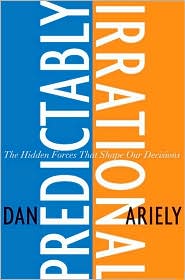
 This was a fun (and very light, very quick) read. There are all sorts of interesting insights into human behavior here. (Warning: one section is a bit graphic--they did research on decision making of aroused males.) Recommended.
Saturday, March 22, 2008
Predictably Irrational: The Hidden Forces That Shape Our Decisions by Dan Ariely
This was a fun (and very light, very quick) read. There are all sorts of interesting insights into human behavior here. (Warning: one section is a bit graphic--they did research on decision making of aroused males.) Recommended.

Wednesday, March 19, 2008
The Last Flight of the Scarlet Macaw: One Woman's Fight to Save the World's Most Beautiful Bird by Bruce Barcott
 This was a very enjoyable read--I don't want to say too much because I don't want to give the game away, but there is a fascinating case study here. Recommended.
The Princess Academy by Shannon Hale
 I read this to the boys. They loved and so did I--this is one of the best written and best plotted YA books I have ever read. Highly recommended.
Saturday, March 15, 2008
The Fortune Cookie Chronicles : Adventures in the World of Chinese Food by Jennifer 8. Lee
 I loved this book. Lee (and howabout that middle name?) covers everything from the Chinese immigrant experience to the link between the American Jewish community and Chinese food to the origin of General Tso's chicken. Highly recommended.
Monday, March 10, 2008
Barbara Bush : A Memoir by Barbara Bush
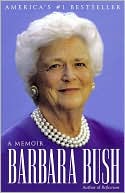 I hate W as much as the next guy, and I wasn't too sure what I'd think of his momma. Well, I adored this book. Bush did a great job conveying her personality and I ended up liking her. She also has some great stories to tell: playing footsie with Yeltsin, rats in the White House swimming pool, etc. Recommended.
Saturday, March 08, 2008

The Invisible Sex: Uncovering the True Role of Women in Prehistory by J. M. Adovasio, Jake Page, Olga Soffer
 This was boring--a mishmash of ideas I had encountered before.

Fork It Over: The Intrepid Adventures of a Professional Eater by Alan Richman
 Eh--there are much better foodie books than this.
Saturday, February 23, 2008
Bound on Earth by Angela Hallstrom

Angela Hallstrom’s debut novel, Bound on Earth, is worth reading.
I know as much about defining a good novel as Potter Stewart knew about defining pornography: I can’t do it but I know it when I see it. And I see it in Hallstrom’s book. The characters are real. The situations are real. The emotions are real. She has done a better job of creating “real” than most authors I have read (notice I didn’t say “most LDS authors”). She gets us into the minds of a five year old, a middle-aged man, a young zealot, and many more characters in only a few paragraphs. And she gets it right. The story of the Palmer family–normal middle-class Mormons–emerges through chapters told from the points of view of different players. They seem real, and I liked them. There are also many great observations here about Mormon culture–including the killer line that “till death do you part” is “what Mormon girls hear when they fail.”
Which is not to say that the book is perfect: the last scene reminds me of everything that I don’t like about LDS fiction as Hallstrom gives in to the saccharine send-off. Also, it reads as if it were a collection of pre-existing essays that she [barely] strung together. (I’m not sure whether this is in fact the case–but since various chapters won awards as independent works it may have been–I’m just noting that the chapters feel only loosely connected.)
But . . . but . . . compared to my other forays into LDS fiction (and I skim a lot of review copies that don’t end up getting reviewed because I’m queasy and weary after five pages), this is a gem.
Cross-posted from Times and Seasons.
Friday, February 22, 2008

Tuesday, February 19, 2008
The Thirteenth Tale by Diane Setterfield
 For once I wasn't disappointed with the ending of a novel. This isn't the best book I've ever read, but it was enjoyable. And did I mention that I didn't hate the ending?
Sunday, February 17, 2008
Charlatan: America's Most Dangerous Huckster, the Man Who Pursued Him, and the Age of Flimflam by Pope Brock
 You just wouldn't think that a book about goat testicle transplants would be that good. You'd be wrong. This may be the most bizarre book I have ever read, but also one of the most interesting. Highly recommended.
Saturday, February 16, 2008
Your Inner Fish: A Journey into the 3.5-Billion-Year-History of the Human Body by Neil Shubin
 I loved this book--it is one of the best-written "science for the layperson" titles that I have come across. I had feelings of awe and reverence as he described the imprint of evolution on human bodies and our commonalities with other animals. Highly recommended.
Friday, February 15, 2008

Wednesday, February 13, 2008
The Terror Dream: Fear and Fantasy in Post-9/11 America by Susan Faludi

This was a great read. (Except for the historical survey at the end, which seemed tacked on.) I admit that making fun of the media's "lifestyle reporting" (i.e., reporting of trends) is no harder than shooting fish in a barrel, but this was still a great book. Her focus on gender issues in media reporting about 9/11 was particularly interesting.
Saturday, February 09, 2008

Friday, February 08, 2008
Sex Sleep Eat Drink Dream: A Day in the Life of Your Body by Jennifer Ackerman
 Tons of fun--full of fascinating research results about the oddities of the human body, with an emphasis on the body's timing systems.
The Botany of Desire: A Plant's-Eye View of the World by Michael Pollan
 I thought I'd love this--I adored Omnivore's Dilemma and I liked In Defense of Food. And the topic is certainly intriguing. But the content was a mishmash of unrelated topics (with, admittedly, some interesting tidbits) and seemed to meander.
The Illuminator by Brenda Rickman Vantrease
 I love historical novels set in the middle ages. But as I find often to be the case with novels for me, I loved the book but hated the ending.
Tuesday, February 05, 2008
A Contract with the Earth by Newt Gingrich
 I listened to this with my husband over several weeks. I was really pleased to see environmentalism championed as a conservative principle and to see environmental solutions based on those principles. But there seemed to be a lot of filler in this book ("we need to work to achieve consensus blah blah blah") but the basic idea was good.
The Nine: Inside the Secret World of the Supreme Court by Jeffrey Toobin
 I really enjoyed this because I like thinking about constitutional law. Even tho the book felt a little gossipy at times. (OK, I kind of liked that, too.)
Saturday, January 19, 2008
People of the Book by Geraldine Brooks
 Holy cow. This is one of the very best books that I have ever read. I don't want to say anything about the story because I don't want to give it away. But it has been years since I've liked a novel this much. Highly recommended.

Thursday, January 17, 2008
The Ordeal of Elizabeth Marsh : A Woman in World History by Linda Colley
 This book ranged from fascinating to dreary.
Saturday, January 12, 2008
In Defense of Food : An Eater's Manifesto by Michael Pollan
 If I had to recommend one book to someone who wanted a readable critique of "the Western diet," this would be it. His history of health advice and fads and laws is enough to make anyone angry. The book isn't perfect (for example, I think he romanticizes native diets by neglecting to mention malnutrition issues and he doesn't distinguish between most processed foods and healthy processed foods, such as bagged salads) but it is very good.
Monique and the Mango Rains : Two Years with a Midwife in Mali by Kris Holloway
 Wow! This is one of those books that everyone should read: a Peace Corp volunteer tells the story of an amazing story of a woman with a sixth grade education and a few months of midwifery training who is the sole source of health care for several villages. Highly recommended.
The Dirt on Clean : An Unsanitized History by Katherine Ashenburg
 If there were an award for which book had the post "ewwww" moments, this one would win. The history of bathing (or, more correctly, the lack thereof) isn't pretty. But this book wasn't very interesting.
From the Mixed-up Files of Mrs. Basil E. Frankweiler by E. L. Konigsburg
 I read this to the boys. They liked it; I thought it was unremarkable.
The Amazing Adventures of Kavalier and Clay by Michael Chabon
 I enjoyed reading this, but at the end felt disappointed. The writing didn't hold a candle to The Yiddish Policeman's Union and the plot was disjointed. I'm not sure why it won a Pulitzer.
Thursday, January 03, 2008
Hittite Warrior by Joanne Williamson
 This was a pre-read for Simon. It probably isn't as good as, say, The Golden Goblet, but given the paucity of sources for this era and place in history, it is worth reading.
River Torn by Peter Hessler
 This was really interesting; I always like books about China. I think he did a good job encapsulating the paradoxes of Chinese culture and politics.
Mrs. Frisby and the Rats of NIHM by Robert O'Brien
 I read this to the boys; they liked it, I thought it was kind of dull.

The Yiddish Policemen's Union by Michael Chabon
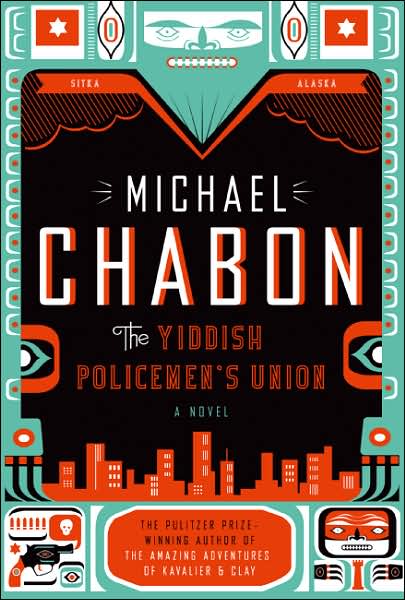 Verdict: really weird and really good. I usually dislike it when I notice the writing (even if I am noticing that it is good) but--wow--Chabon is something else. Amazingly creative metaphors and similies. Recommended.
The Abstinence Teacher by Tom Perrotta
 There was so much potential here with a story of the culture war writ small, but it fizzled at the end.
Monday, November 19, 2007
The Beginning of Wisdom: Reading Genesis by Leon Kass
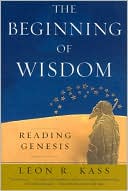 I've read about a dozen commentaries on Genesis now; this one is by far the best. Which isn't to say that it is perfect (I thought the handling of the Joseph cycle was a little weak) but--wow!. If you read only one book on Genesis, this should be it.
Tuesday, November 13, 2007

Monday, November 12, 2007
Working the Divine Miracle: The Life of Apostle Henry D. Moyle by Richard D. Poll
This was one of the less interesting biographies that I have read. I also think that Poll may have overplayed his loss of power, but I'm not convinced either way.
Saturday, November 10, 2007
The Odyssey retold by Geraldine McCaughrean
 I pre-read this for Simon's history reading. I thought it was wonderful and would make an excellent read-aloud for kids as young as five. Kids 8+ could read it themselves.
Friday, November 02, 2007
Latter-day Saint Courtship Patterns edited by Mary Jane Woodger
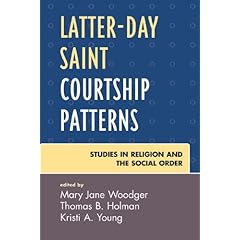 Latter-day Saint Courtship Patterns is part of Studies in Religion and the Social Order, which is edited by Jacob Neusner. Many interesting tidbits gleaned from the data would make fun discussion topics (only 22% of BYU men and 29% of BYU women expect that a “spiritual confirmation” will help them know when they have found the person they should marry; 60% of BYU freshman think it is wrong to kiss on the first date while only 20% of older students thought the same). But it is hard to overlook the major flaw of the book: every study which included information about its survery population indicated that the participants were all BYU students (or high school students from the Orem and Springville areas). For those studies where the institutional affiliation(s) of its participants were not mentioned, every indication is that they also were BYU students. (One of the folklore essays did indicate that one-third of its participants were from outside of the “Mormon belt.”) So the book is, I think, improperly titled: it isn’t about LDS courtship patterns or even American LDS courtship patterns, but rather about the courtship patterns of BYU students. I’m guessing those aren’t coterminous groups. Not only do I have philosophical objections to letting BYU culture stand proxy for the Church, but a non-LDS researcher who approaches this work will be left with the impression that “creative dating” is a Mormon thing, not a Jell-o Belt thing. And while I’m not a sociologist, some of the research methodology seemed suspect to me, such as comparing the opinions of BYU students to a national sample of high school students. Similarly, a few studies used ‘grounded theory,’ which not only seems to have the potential to find nothing other than what the researcher wanted to find, but in the case of the essay on females in relationships seems (based on the quotations provided, which don’t support the hypothesis) to do just that. It is hard to take seriously conclusions based on interviews with only fifteen different subjects or a four-page piece on wedding receptions. I find sociological research on the Church and its members fascinating and hope that this book will pave the way for more work in the field–work that has larger, more diverse samples and more rigorous methodology.
Piggyback Rides and Slippery Slides - How to have fun raising first-rate children by Lynnae Allred
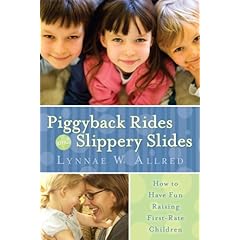
Do you really need to read a book on how to play with your children? Maybe. Lynnae W. Allred’s new book, Piggyback Rides and Slippery Slides; How to Have Fun Raising First Rate Children, may not exactly be a necessity, but it could be a blessing. In a world where people enroll their three-month-old babies in classes and buy phonics toys for infants, it is safe to say that some parents don’t have a clue as to what is developmentally appropriate or necessary for children. To the extent that this book will help parents who need a little help fending off today’s excesses of hyper-parenting (or who didn’t see good parenting modeled by their own parents), it is, as Martha would say, a good thing. It also has some innovative ideas on making chores and that sort of thing more fun (hint: turn out the lights and aim your searchlight [flashlight] at the grenade that is about to explode [toys, dirty clothes] and see if your child can defuse [put away] it before it explodes in ten seconds). I wasn’t thrilled with her hyperbolic and over-generalized description of the differences between how fathers and mothers play with their children, but I was very pleased with her critique of over-scheduling.
Eighteen Months: Sister Missionaries in the Latter Days edited by Melissa Baird Carpenter
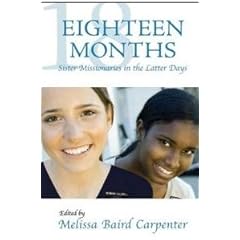
Eighteen Months: Sister Missionaries in the Latter Days, edited by Melissa Baird Carpenter, is a “collective memoir” of the mission experiences of many sister missionaries, including T& S's own Rosalynde Welch. Most essays succeed marvelously in hitting the sweet spot of spirituality without succumbing to the saccharine; we are introduced to the bulimic companion and the golden investigator and both are made equally real. While not all essays evince the best writing style (and a fair number of typos mar the book as well), the genuineness of the stories overcomes these flaws. From ruminations on how the local transvestite manages to keep his makeup immaculate in the humidity to visiting a new convert in prison, it’s all here and it’s well worth reading.
Indian Summer by Alex von Tunzelmann
 I don't know that I've ever read a book that was such a mix of fascinating detail, notably good reading, and dry-as-dust detail.
Sunday, October 14, 2007
The Year of Living Biblically by A. J. Jacobs
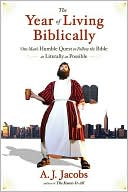 Jacobs, who described himself as being Jewish in the same way that The Olive Garden is Italian, spends a year trying to live, as literally as possible, every commandment in the Bible. He also visits fundamentalists of various stripes throughout the year. The results are hilarious and thought-provoking. Highly recommended.
Wednesday, October 10, 2007
Well-Behaved Women Seldom Make History by Laurel Thatcher Ulrich
 Laurel Thatcher Ulrich is my hero and I don't say that lightly. This book is way fun. Her other works have taken a small slice of life and looked in-depth (anyone who hasn't read A Midwife's Tale needs to stop what they are doing right now and go read it), but this book covers the entire enchilada. What is most fun about this book is that instead of plodding along chronologically, she works thematically. This book will, I'm sure, become a standard text for intro to Women's History and similar classes. And it should be. But it is also buckets of fun and would be a great choice for a high-school aged homeschooler.
Saturday, October 06, 2007
The Arms of His Love: Talks from the 1999 Women's Conference
Years ago, I loved the Women's Conference books. Now, they barely hold my interest. I'm not sure if the books have changed or I have. Maybe both.
Thursday, September 27, 2007
The Zookeeper's Wife by Diane Ackerman
A charming tale of a Polish woman who hid Jews in her zoo. The gentle humor of a life surrounded by animals nicely balances the terrors of Nazi occupation. Recommended.
Wednesday, September 19, 2007
Setting the Record Straight: Blacks and the Mormon Priesthood by Marcus H. Martins
Millennial Press has a new series of short books on controversial topics. The volume on the priesthood ban was written by Marcus H. Martins, a Brazilian who joined the church in 1972 and would later be the first post-1978 full-time missionary of African descent. He speaks with a faithful voice; he's the chair of the Department of Religious Education at BYU-Hawaii. 
The best parts of the book are his personal experiences with living the gospel as a man of African descent both before and after 1978. He related that he is often asked why his family joined a church that didn't allow them to take part in the priesthood. His heartbreaking but perfect response, based on John 6:67-69: "We had nowhere else to go."
But most of the book is, as the back cover puts it, "deeply doctrinal" and not personal. This causes a problem as all one can say with surety about the priesthood ban is this:
(1) We don't know the reason for the ban.
(2) Everything you've ever heard justifying the ban was Mormon folklore and should be ignored; see statements from Elder McConkie and, more recently, Elder Oaks to support this idea.
So Martins says those things. But that isn't enough to make a book, not even one that's a slim 83 pages. What Martins adds often feels like filler and in some cases detracts from his overall message. For example, at one point he makes the argument that the ban wasn't an eternal law, but a custom. He uses a system of classifying laws in order to make this point. Unfortunately, this leads him into unnecessary and bizarre conjecture ("We may assume that electromagnetism and perhaps even the weak and strong nuclear forces might also be controlled by the Holy Ghost.")
He spends some time logically (and scripturally) debunking the more common folk doctrine. And his arguments are pretty good, but they miss the main point: the purveyors of the folklore he is disputing were people sustained as prophets, seers, and revelators. So logical arguments are all well and good, but the real issue is the authority with which the person spoke when making the statement. But Martins doesn't address how problematic it is when he is saying (in effect, because he doesn't name names): "This argument, made by Joseph Fielding Smith or Bruce R. McConkie, is incorrect because it is not scriptural." This, of course, leads to a larger question (that Martins doesn't address): If previous church leaders were guilty of promulgating folklore to explain practice, then could current leaders be doing the same? How does this knowledge of the past affect how we view the present? These may be some of the most troubling questions related to the priesthood ban for twenty-first century Mormons and so it is disappointing not to see them addressed here.
While I'm no expert on the history of the priesthood ban, there were a few statements Martins made that caught me short. In one case, he referred to "the Prophet Joseph Smith's opposition to the ordination of Blacks." But my understanding is that there is no scholarly consensus as to the origin of the ban and that many scholars locate it in the time of Brigham Young, especially since Joseph Smith ordained Elijah Abel, a black man. Martins also seems unaware of the material in the recent biography of President McKay, which contains statements that contradict his assertions that "the Lord appears to have been mostly silent about the issue until June 1, 1978" and that "the leaders of the past had already discussed the matter, and that because they had no ideas of their own to add, they didn't see any need for further discussion." (This latter statement is also contradicted by the efforts of J. Reuben Clark as described in Quinn's biography of Clark.) It is also unfortunate that Martins uses Acts 10:15 to sum up the section where he argues that the Lord only revealed the end of the ban when Church leaders showed interest in it, since the scripture from Acts shows the Lord ending a similar ban (i.e., on eating with Gentiles) that was most certainly not requested by the prophet at the time.
Despite these flaws, I am pleased that Millennial Press has issued this series of books and pleased with Martins' presentation of the issue in general.
Cross-posted from Times & Seasons
The best parts of the book are his personal experiences with living the gospel as a man of African descent both before and after 1978. He related that he is often asked why his family joined a church that didn't allow them to take part in the priesthood. His heartbreaking but perfect response, based on John 6:67-69: "We had nowhere else to go."
But most of the book is, as the back cover puts it, "deeply doctrinal" and not personal. This causes a problem as all one can say with surety about the priesthood ban is this:
(1) We don't know the reason for the ban.
(2) Everything you've ever heard justifying the ban was Mormon folklore and should be ignored; see statements from Elder McConkie and, more recently, Elder Oaks to support this idea.
So Martins says those things. But that isn't enough to make a book, not even one that's a slim 83 pages. What Martins adds often feels like filler and in some cases detracts from his overall message. For example, at one point he makes the argument that the ban wasn't an eternal law, but a custom. He uses a system of classifying laws in order to make this point. Unfortunately, this leads him into unnecessary and bizarre conjecture ("We may assume that electromagnetism and perhaps even the weak and strong nuclear forces might also be controlled by the Holy Ghost.")
He spends some time logically (and scripturally) debunking the more common folk doctrine. And his arguments are pretty good, but they miss the main point: the purveyors of the folklore he is disputing were people sustained as prophets, seers, and revelators. So logical arguments are all well and good, but the real issue is the authority with which the person spoke when making the statement. But Martins doesn't address how problematic it is when he is saying (in effect, because he doesn't name names): "This argument, made by Joseph Fielding Smith or Bruce R. McConkie, is incorrect because it is not scriptural." This, of course, leads to a larger question (that Martins doesn't address): If previous church leaders were guilty of promulgating folklore to explain practice, then could current leaders be doing the same? How does this knowledge of the past affect how we view the present? These may be some of the most troubling questions related to the priesthood ban for twenty-first century Mormons and so it is disappointing not to see them addressed here.
While I'm no expert on the history of the priesthood ban, there were a few statements Martins made that caught me short. In one case, he referred to "the Prophet Joseph Smith's opposition to the ordination of Blacks." But my understanding is that there is no scholarly consensus as to the origin of the ban and that many scholars locate it in the time of Brigham Young, especially since Joseph Smith ordained Elijah Abel, a black man. Martins also seems unaware of the material in the recent biography of President McKay, which contains statements that contradict his assertions that "the Lord appears to have been mostly silent about the issue until June 1, 1978" and that "the leaders of the past had already discussed the matter, and that because they had no ideas of their own to add, they didn't see any need for further discussion." (This latter statement is also contradicted by the efforts of J. Reuben Clark as described in Quinn's biography of Clark.) It is also unfortunate that Martins uses Acts 10:15 to sum up the section where he argues that the Lord only revealed the end of the ban when Church leaders showed interest in it, since the scripture from Acts shows the Lord ending a similar ban (i.e., on eating with Gentiles) that was most certainly not requested by the prophet at the time.
Despite these flaws, I am pleased that Millennial Press has issued this series of books and pleased with Martins' presentation of the issue in general.
Cross-posted from Times & Seasons
Body of Work by Christine Montross
 A mildly interesting memoir of the author's experience dissecting a human body as a first-year med student. A better book on this topic is Mary Roach's Stiff.
Saturday, September 15, 2007
Elder Statesman: A Biography of J. Reuben Clark by D. Michael Quinn
 Good stuff, but definitely not for the faint of heart. Reading a book like this with its cringe-inducing GA squabbles, errors, and extremely bizarre personal opinions taught over the pulpit is almost enough to make one a believer in 'faithful history.' Clark certainly was an odd duck.
Tuesday, September 11, 2007
On the Road with Joseph Smith by Richard Bushman
 I can't remember that last time I enjoyed reading a book this much (and I'm not just saying that because my name was on page 78). This is essentially Bushman's diary from the year after Rough Stone Rolling was published and he muses on everything from sales rank at Amazon to the deeper issues of non-member perception of Joseph Smith. There's a blog post on nearly every page of this book--it is that discussion-worthy. Highly recommended.
Subscribe to:
Posts (Atom)