Saturday, August 12, 2006

Word Biblical Commentary: Isaiah (Volumes 34 and 35)


This was OK, but just OK. I'm not sure how much to blame the commentaries I read and how much to blame Isaiah, but this was a very disappointing experience for me. It may be that the Book of Mormon led me to expect to get so much out of Isaiah, and it just didn't happen. It may be that I was expecting to 'get' Isaiah in a way that I hadn't before, and that (despite the hundreds--thousands--of pages I read) didn't happen. I don't know. In any case, this is the first time that I have studied a book in depth only to like it less at the end than I did before. Again--whether the fault belongs to the commentaries I read or other factors, I can't say. But I'm sure glad I'm done with Isaiah.

The Prophecy of Isaiah by J. Alec Motyer

This is a solid commentary. I wish he had spent a little less time defining words, and there is a certain 'spark' I get from the truly great commentaries that wasn't here, but this was OK. If it sounds like I'm darning with faint praise, it is because I am.

Isaiah: Prophet, Seer, and Poet by Victor Ludlow

This is the only LDS commentary that I have ever read that is worth recommending. I think he occassionally adopts traditional LDS positions that don't have enough to support them, but for the most part, this is responsible scholarship. At the same time, I think it only removes about 40% of the Isaiah fog--readers who want more than that will be disappointed.

Thursday, August 10, 2006

Misquoting Jesus: The Story Behind Who Changed the Bible and Why by Bart Ehrman

This is an important and fabulous book. Very little of the material was new to me, but it was still a very useful read to have a basic introduction to textual criticism wrapped up in a nice, neat little package instead of scattering all over--the way that I picked it up in school. While this book would be a killer for someone who thinks the scriptures are inerrant, I think a fairly conservative Saint could handle it--the confirmations of the Church's attitude toward scripture ("insofar as it is translated correctly" and "corrupt and designing priests" come to mind) will be enough to tide them over through the tough parts. (I don't think most people know that the story of the woman taken in adultery is not original to the text.) This book is highly recommended to anyone with any interest in the Bible and is essential reading to anyone who wants to seriously study the scriptures.

The Mommy Brain: How Motherhood Makes Us Smarter

I just wasn't that interested in this. The thought that chemical changes brought on by pregnancy, lactation, and mothering might permanently change brain chemistry is certainly interesting, but I don't think there is enough data to really make her case. One can only read the phrase 'rat mother' so many times . . . and then the obligatory liberal-agenda-to-make-working-motherhood-painless at the end was extremely annoying.

Sunday, August 06, 2006

T. Edgar Lyon: A Teacher in Zion by T. Edgar Lyon, Jr.

Brother Lyon, along with Lowell Bennion, taught at the U of U Institute in its formative years and represented an early, liberal strand of the CES. Lyon and Bennion left the U of U under unpleasant circumstances in 1962. T. Edgar Lyon's story may not be for the generalist, but it captures important data points in the growth of CES and the dramatic changes that affected the Church throughout the twentieth century.

Friday, August 04, 2006

The Lemon Tree by Sandy Tolan

I listened to this on our Utah trip; it was phenomenal. I suppose I was expecting a quaint story of how a Jew and a Palestinian became friends; their tortured friendship is about ten percent of the book--the rest is a concise and fascinating history of Israel/Palestine. I had no idea how much I didn't know until I listened to this. Highly recommended.

Thursday, August 03, 2006

King Leopold's Ghost by Adam Hochschild

(I reviewed this a few weeks ago but apparently my review is lost in cyberspace.)

This was a tremendous book--absolutely required reading. King Leopold of Belguim was a fascinatingly diabolical character and his exploitation of the Congo was beyond belief. And, as if all of that isn't bad enough, as the story is winding down and things seem to normalize, we find out that the CIA killed the first democratically-elected leader of the Congo. Unbelieveable. This well-written tale is much stranger--and more interesting--than fiction.

Morning by Morning: How We Homeschooled Our African American Sons to the Ivy League by Paula Penn-Nabrit

This was disappointing. I suppose I imagined a WTM-type book, but this was short on details and long on her tale of racial woe. I 'get' the idea that the real problem in this country is that if you are a minority, you never know if the waitress' rudeness is because of her or because of you, but I seriously doubt that the stewardess who saw her family sitting in first class and asked, "What are they doing here?" was making a racial statement. Unless they were flying Confederate Air, I suspect such sentiments (which may very well exist) would at least be kept under wraps. In any case, there were a few interesting tidbits about homeschooling in general and about the juxtaposition of homeschooling and racial issues, but for the most part, this felt like a moralizing rant. Not to mention a bit of false advertising: How could that subtitle neglect to mention that one of those sons was kicked out of Princeton? Which brings us to a bigger issue: apparently their effort to have [almost] exclusively African or African-American male tutors backfired. This almost turns the book into a cautionary tale, but you'd never guess that from Penn-Nabrit's tone.

Monday, July 24, 2006

The Blind Assassin by Margaret Atwood

I didn't like this at all. I hate novels that make me feel stupid and I don't think it clever to withold the identity of major characters. It felt like Atwood was being cheap, lazy, and acting like a circus barker. Ack.

Wednesday, July 19, 2006

Benjamin Franklin by Walter Isaacson

This started out as an amazingly strong read and then got a little flabby what with all the diplomacy. But that may be me--I've never been much for diplomacy. Slightly recommended.

Candy Freak by Steve Almond

I listened to the audio of this book on the Texas-Utah trip. It was perfect car audio: light, humorous, and made me wanna snack. I imagine that if I had actually read it, however, it would have felt like empty calories.

Saturday, July 08, 2006

Book Reviews: Juvenile Non-Fiction

If you are an adult, inevitability comes in the form of death and taxes. If you are a child, it comes as the middle school research project.

This means that there is an entire genre of books geared to children of that reading and maturity level on the entire spectrum of possible paper topics. And this, in turn, means a handful of titles about the Church. I want to review some of these books since they will be, for perhaps thousands of children, their first exposure to the Church of Jesus Christ of Latter-day Saints.

Book Cover

Mormonism by Corinne J. Naden and Rose Blue

The first thing we have to grapple with here is the cover, which is a scene from the Hill Cumorah pageant. I wish they had chosen something else since this shot conveys the impression that Mormons spend their time wearing klan robes and blowing on really long trumpets. The same picture is reproduced inside the book, where a caption noting that “Mormons believe that humans are potential gods” only makes it weirder. The idea of human deification is mentioned at least a half dozen times in this book; by contrast, there are virtually no references to Jesus Christ.

Of course, members, sympathizers, and antis will have different opinions as to what constitutes an appropriate emphasis for a book on the Church. But errors of fact are quite a different matter and this book is riddled with them. Here are some things that children will find in this book:

–Church members use ‘thee’ and ‘thou’ in talks.
–The church forbids interracial dating marriage.
–”The church itself is governed exclusively by Americans.”
–The infamous (and retracted) statement that “when our leaders speak, the thinking has been done.”
–The church threatens to excommunicate those who don’t pay their tithing.
–”The family home evening is an example of how the Mormon Church controls most private aspects of life.”
–”Members [of the Relief Society] often serve as home-visiting teachers.”
–Women are discouraged but not forbidden to serve as Sunday School presidents.
–The Book of Mormon is a history of people “who had lived in Central America thousands of years before the time of Jesus.”
–”At the temple baptism ceremony, the person standing for the dead is ritually washed, anointed with oil, and dressed in white temple garments.”
–A picture showing an LDS couple with their food storage is tagged “Mormons take practical steps to prepare for the millenium.”
–Seminary consists of “after-school study classes.” (Don’t they wish!)
–An endowment is performed “once in a lifetime.”
–”Finally, they go to the celestial room, where presumably the actual [endowment] ceremony is performed.”
–A reference in the section on MoTab to “the temple’s magnificent organ.”
–References to “celestial heaven” and “Relief Society of Women.”
–The chapter on Mormon doctrine has virtually no mention of Christ, but subsections titled “Polygamy,” “The Millenium,” and “A Clannish People,” where we learn that “the general belief is that if a non-Mormon family moves next door to a Mormon family, the newcomers will be treated kindly, but they will never be more than casual neighbors.”

The structure of the book is also frustrating, as it shuttles between a historical narrative and sections on people and doctrine. This means that some topics are mentioned repeatedly, such as–of course–polygamy. And while Joseph Smith and Brigham Young get a few chapters, one gets the sense that the Mormons haven’t done anything in the 20th or 21st centuries. In other words, this book is not so much about “Mormonism” as it is “19th Century Mormon History.”

GRADE: D+ I did not think they were hostile so much as they were misinformed. Each of the authors is credited with dozens of children’s books; neither is an expert on the Church. It seems a pity that they couldn’t have asked one real member to review the book; so many little mistakes and, perhaps, big problems of emphasis could have been fixed.

Book Cover

Mormon Faith in America by Maxine Hanks and Jean Kinney Williams

One would have thought that with an actual (albiet former: Hanks was one of the ‘September 6′) Mormon as the author, there would be fewer errors in this book than in Mormonism. Surprisingly, this is not the case; here are some things that your neighborhood middle school student will learn from this book:

–The Nauvoo temple was “the first temple built by early members of the church.” (Later on, a picture of the Kirtland Temple is labelled the first temple.)
–Lesbian and gay members are “excommunicated when they reveal their sexual orientation.”
–A patriarchal blessing is given by “a patriarch or elder.”
–The dedication of graves is one of the temple ceremonies.
–CES has offered elementary and secondary education in underserved areas since 1977 (actually since the late 19th century) and “it now operates about 10,000 elementary or secondary schools.”
–Missionaries serve in “over 200 countires” (lds.org lists 141 countries; while it is debatable, most sources list the total number of countries in the world as about 193). Similarly, there are LDS congregations in “more than 200 countries.”
–From a timeline under the year 1852: “a revelation that polygamy is no longer to be practiced is announced publicly.”
–”Missionaries are discouraged from watching television.” (You can just see it, can’t you: “But President–it’s only discouraged!”)
–RMs get a tuition discount at BYU.
–Pioneer Day is “like Christmas and the Fourth of July in one.”
–Family Home Evening means “shar[ing] a meal and perhaps scripture readings together.”
–President Hinckley has a “program” to “further integrate the LDS Church into the mainstream and has called upon members and observers alike to stop referring to the Church as Mormons or even Latter-day Saints, but simply as the Church of Jesus Christ.”
–Mormons never practiced polyandry.

There are also numerous typographical errors: “Jeredites,” “nearly 112 million members worldwide,” “Thurim and Umim,” and “the national tragedy [on] September 11, 2002.”

You can see the hand of not only a Mormon but a Mormon intellectual in this book. When she introduces the Book of Mormon, she describes it thus: “The book was said to have been inspired by God, with the gold plates being used as a sort of code-breaker that enabled Smith to decipher the word of God, as given to him by the angel.” That’s a definition only a liberal Mormon could love! Similarly, the subsection “Women and the Mormon Priesthood” is precisely the same size as “Mormon Priesthood,” which is an allocation of attention that only a liberal could love. Hanks writes that “women share in the priesthood with their husbands, and they perform women’s priesthood rites in the temples. Mormon women in the 19th century participated more in priesthood functions–such as blessings and healings–were ordained to offices, and presided over the women’s Relief Society.” Later, the book notes that “blessings are also given for those who are ill or in need, or by a father or mother.” On a timeline with less than 20 dates, we learn that in 1930 “women’s blessings and ordinances are forbidden.” (The perceptive reader will note that this contradicts the previous data points.)

GRADE: D+ Like Mormonism, this text becomes terribly confusing and redundant as it alternates between historical and theological topics. This title does do a better job (but only slightly) on 20th century church history. The definitions for LDS terms in the sidebar are also helpful. But the errors and misrepresentations are disturbing, especially coming from an author who should know better.

Book Cover

The Mormons by Jean Kinney Williams

Interestingly, Jean Kinney Williams is listed as the second author on the Hanks book. But this book is an entirely different beast. What is most notable is that the prose is substantially better: it reads like a story, not a textbook. That alone is enough to recommend it. There are very few questionable lines (the worst I could find was: “Joseph said that The Book of Mormon, with its story of the ancient band of Israelites who fled to the New World, contained all the information necessary about how the church was to be structured in modern times.”) and no obvious errors. The book feels even-handed. It doesn’t sound like it came out of correlation, but neither does it read as if the author is only shallowly acquainted with the Saints or has a deeper need to ax-grind. While it is limited, as the other books are, to black and white illustrations and photos, the pictures are sharp and interesting. And the book doesn’t alternate between doctrine and history like the other titles do: it proceeds strictly chronologically and therefore flows much more smoothly. But this means that there is very little in the book about current church practice; “A History of the Mormons” would have been a better title. But the summary of “Mormon life” that she squeezes into a few brief pages at the end is not only error-free and surprisingly successful at capturing the feel of the church, but also interesting. Instead of simply giving a laundry list of Church programs, she explains them through the lens of the life of one LDS family. This is an excellent book.

GRADE: A Even-handed and accurate.

Book Cover

I Am a Latter-day Saint (Mormon) by Gayla Wise

To be fair: this book is an entirely different genre from the last three; it is aimed at emergent readers, perhaps a first-grader learning about individual differences. Our family has read several titles from this series (I Am a Hindu, I Am Jewish, I Am Muslim) and they are charming. Since they are written from the point of view of a child who is an adherent, they have a sweetness about them that is unparalleled: “My favorite part of the Book of Mormon is when Jesus visits the people of the Americas right after his death and resurrection.” I was very pleased to see that, after a brief introduction, the very next page was a statement about Jesus Christ. This book is nearly perfect in every way: it covers basic doctrine and lifestyle, it is fair, and the emphasis is right. I think all Saints would recognize their church in this book and feel that they had been fairly treated. This would be a good title to read to LDS children, to share with a nonmember neighbor, or to donate to your elementary school’s library.

GRADE: A+ I can’t really think of any way to improve on this book.

A final note:

All three of the books geared to middle school students addressed polygamy at length, as well as other elements of Church history that don’t make it through correlation. I’m working through in my mind the ramifications of a good little Mormon kid who decides to do a research report on the Church (”It’ll be a missionary opportunity when I do my class presentation!”) and finds on page 20 that Joseph Smith married a sixteen-year-old girl who lived in his home in Kirtland and then lied publicly about his marriages. Even more cringe-inducing is the thought of a Primary-age child reading the descriptions (some accurate, some not) of the temple ceremony in the Naden and Hanks books. This is more food for thought in the ongoing discussion of the best way to approach the more complicated issues in Church history.

The Emperor of Ocean Park by Stephen Carter

This was an excellent book: it worked on so many levels. It was a great thriller, well written, with trenchant tidbits of commentary on everything from race, class, academic politics, and the arrogance of (some) childhood development gurus worked in. Highly recommended.

Monday, July 03, 2006

The Amateur Marriage by Anne Tyler

So on the one hand I enjoyed reading this but on the other, I felt cheated somehow when it finished--as if I were waiting for something to happen that never did. Tyler has a reputation for writing about the ordinary lives of ordinary people. I suppose if that is what you are in the market for, this would be a fine choice. But as an ordinary person living an ordinary life, I want my fiction to be something else, and this wasn't.

A Rascal by Nature, A Christian by Yearning: A Mormon Autobiography by Levi Peterson

Peterson writes: “I don’t recall weighing whether ther might be an audience for my life’s story. I simply wanted to write it.” And thus the problem: there are strands of interesting material here for several different books (a generic autobiography, a psychobiography, an intellectual biography, a writer’s history, a wilderness journal) that aren’t integrated. Readers interested in the background to his fiction will be at least as irritated by irrelevant material as they are thrilled by his lengthy reflections on his work, while readers looking for insights into his “vexed and vexing relationship with Mormonism” may tear their hair out over passages like this one:

I felt sharply the deep duplicity of my life–my possession of distinctly different personas in conservative and liberal environments, and wondered again how I could bridge the two worlds without being insane, and feeling again it is precisely because I do bridge them that I’m not insane.

And then, after nothing more than a paragraph break, this:

In May 1994 I bought a new electric-blue Ford Ranger pickup with a sluggish four-cylinder engine and a five-speed conventional transmission. As it turned out, I would own this vehicle for ten years to the day. The vinyl cover on the bench seat cracked early . . .

I doubt that I’m the only reader who wishes that the statement about conflicting personas had gotten a little more development even at the cost of slighting the next segment of Peterson’s automotive history. His curious relationship with the institutional church (he was devastated at the thought of excommunication but likes coffee “mostly because it is a convenient sin. It is a very handy, inexpensive way to stay out of harmony with your church.”) is something that I kept patiently waiting for him to explore in some detail, but he never did. He does make several snide-sounding comments about the Church. On the sacrament prayers: “Apparently, God will not sanctify the tokens of redemption unless you get the words just right.” On eternity with his non-LDS wife: “God will not be so petty and mean-spirited as to deny those who have loved each other in mortality to continue their love in immortality. It is love that sanctifies and seals a relationship, not a ritual conducted before an altar made by human beings.” While these sentiments deserve comment on quite a few levels, I’ll restrict myself to the irony: for someone who sees himself as a ‘loyal dissenter’ ministering to the marginalia of Mormonism, he must realize how grossly unsatisfactory two sentences are for dismissing the capstone of Mormon theology. Some readers will also be put off by the depth of his exploration of his sexual history, although he does offer an interesting apologia for this near the end of the book. Nonetheless, Peterson is a fabulous storyteller who made me actually care about his mother’s tumultuous first marriage and his ancestral connection to Mormon history. For the reader who can tolerate unexplored caves (”a fierce, proud grief lies at the core of the Mormon identity, cemented there by the hardships, smothered aspirations, and truncated lives of our pioneer ancestors”), this will be an interesting book. But for those who want more fleshing out, this will be a frustrating read.

An Advocate for Women: The Public Life of Emmeline B. Wells by Carol Cornwall Madsen

I’ve written before on the need for more biographies of LDS women, so I was predisposed to like this book. But I couldn’t even finish it; I admit, guiltily. The main problem was this: Cornwall Madsen’s approach is to bifurcate the “public” and “private” lives of Wells. (One gets the impression that another biography–covering her private life–is forthcoming.) But as every feminist knows, the personal is political: how could it not be when the main issue of the protagonist’s life is polygamy? Without the backdrop of Well’s private life, I couldn’t peg the events in her public life. Cornwall Madsen seems to inadvertently make the case for combining Wells’ stories when she writes:

As for her contributions to the Exponent, the decade of the 1870s that brought her periods of disillusionment and unhappiness also produced some of her sharpest feminist critiques and opened a broad new avenue of experience for her. The private despair of her middle years gave way to heightened pleasures in her public life. Out of the depths of her own private battles, she created the feminist manifesto that initiated a lifelong commitment to the advancement of women.

With statements like these, it seems hard to rationalize the separation of Wells’ public and private personas. And I don’t wish to be overly critical, but a second major problem was that the prose just didn’t hold my attention. Because I have read everything that I’ve ever written, I have a pretty strong stomach for colorless writing, but I still found this book dull. I’m not sure why Cornwall Madsen uses such odd phraseology as “the woman movement” or “woman suffrage” instead of the more common and felicitous alternatives, but they don’t help the lackluster prose. I don’t need my historians to be wordsmiths, but I need more than this to hold my attention.

Wells’ story is important; her defense of polygamy provides an interesting warp to the weft of modern feminism: “polygamy advanced woman’s status by making her less subordinate and more independent than monogamy, with more opportunity for personal development and a share in the world’s work.” Unfortunately, this volume doesn’t do justice to Well’s legacy.

Contemporary Mormonism: Latter-day Saints in Modern America by Claudia Bushman

I believe this book is meant to be read in an Intro to American Religions class or used for research at the undergraduate level. Bushman has done an admirable job by eschewing the dry prose that one expects from a ‘textbook’ in favor of a storyteller’s approach. This doesn’t mean her approach is flawless, however. Bushman makes several statements that might be good debate material for Mormon intellectuals, but don’t stand on their own as unsubstantianted, unnuanced statements in a work intended for nonspecialists. For example, she constrasts “the basic split between the mystical religion of magic and folklore” with “the rational world of college-educated members.” Similarly, she notes that “speakers in local wards have great freedom, [while] those who speak or write to wider audiences are carefully scrutinized.” (I wouldn’t claim that either statement is necessarily false,but rather that they are a lot more complicated than that.) I also question her choice of material: Do Orrin Hatch’s mezuzah and David Brian Mitchell really belong at the beginning of a chapter on the church’s basic beliefs?

More serious than her own choices, however, are those made by her editor and publisher. I think they let her down. Here’s the first quote from the back cover:

“A welcome alternative to the Mormon blogs that only praise or only condemn this fascinating church, Contemporary Mormonism is friendly, objective, probing and very, very informative. Claudia Bushman has done us all a great service.” –Carol Lynn Pearson

Well, since you are reading a Mormon blog, you know how jaw-droppingly incorrect that statement is, so I won’t belabour the point. Unfortunately, several similar slips mar the text. The book is obviously written for nonmembers, but terms including correlation and family home evening are mentioned but not defined. Page 4 features a restatement of statistics that had already been mentioned in the text. Perhaps most surprising was the frequency with which typographical errors appeared in the few chapters that I read.

There is a real need for works sympathetic to the Church to be available to students of all ages, but this text is problematic on several fronts. A better alternative is The Latter-day Saint Experience in America.

Saturday, June 24, 2006

Paul's Letter to the Romans: A Socio-Rhetorical Commentary by Ben Witherington

Well, I didn't hate this one as much as the other two, but I still couldn't finish it. I don't think the problem was Witherington; I think it was Paul. I don't like the epistles.

Wednesday, June 21, 2006

Mormonism in Transition by Thomas Alexander

This book alternated between fascinating and dry as dust. A worthwhile if not page-turning read.

Tuesday, June 20, 2006

Romans by Thomas Schreiner

I made it through Romans five of Schreiner's and Moos' commentaries on Romans (that's about 600 pages!) and then I had to quit. I had looked forward to working through these books so much and for so long, but it was awful. I hated both of these. They barely engaged the text but rather theologized on the implications of what Paul was saying. ugh.

The Epistle to the Romans by Douglas Moo

See above. ugh

Tuesday, June 13, 2006

Leviticus as Literature by Mary Douglas

I got this largely because Douglas' Purity and Danger caused a not-so-quiet revolution in the understanding of the purity laws. But despite a few interesting insights, I found this hard to wade through, maybe because she is an anthropologist and I wanted her to write like a biblical studies person. Uneven, but interesting.

Leviticus by Jacob Milgrom

I seriously considered buying his three-volume Anchor Bible Commentary since it is the definitive work on Leviticus, but wasn't sure I could stomach the 2500 pages--or the price. I was thrilled when I found this title at Amazon billed as a distillation of the key insights from the Anchor series. But it was a disappointment. He wastes time on all sorts of borderline-irrelevant topics (Alchoholics Anonymous, an entire page of statistics on modern slavery, etc.) and generally didn't provide much bang for the buck. The NICOT was much better.

Leviticus (NICOT) by Gordon Wenham

This was the best of the lot and if I could only have read one title on Leviticus, it would have been this one. I discovered the NICOT/NICNT series with the Ezekiel title which I thought was fabulous (although I read part of the Acts title online and thought it was too fluffy). The main strength of this title was that it presented solid exegesis (taking both Milgrom and Douglas into account) and then, separately, covered the relationship between Leviticus and the New Testament. If you wanted to read one volume on Leviticus, it would be this one.

Holiness to the Lord: A Guide to the Exposition of the Book of Leviticus by Allen Ross

I normally shy away from commentaries for expositors but I felt that it might be worthwhile to bend that rule a little for Leviticus. This was pretty good but not essential.

Monday, June 05, 2006

What to Eat by Marion Nestle

I found this mildly entertaining; there isn't much new here if you are familiar with basic nutrition principles and issues. (However, this would be an excellent book for someone who wasn't familiar with those things.)

Saturday, May 27, 2006

The Acts of the Apostles: A Socio-Rhetorical Commentary by Ben Witherington

It was fun to work through Acts with this book and Fitzmyer's. They were a good balance: Fitzmyer solid and predictable, Witherington with an eye toward feminist and literary concerns. If you think you can stomach 1600 pages of commentary on Acts, working through the text passage by passage as you read these two books is a great exercise.

The Acts of the Apostles by Joseph Fitzmyer

This was a solid commentary on Acts. There were several annoying formatting issues (I think that 'notes' belong before 'comments' and that an entire paragraph of citations--plunked in the middle of the commentary--is irritating.)

Summer Sisters by Judy Blume

I read this on the beach. It was completely vapid.

Seabiscuit by Laura Hillenbrand

This was a wonderful book--it is a real mark of a good author to make an uninteresting (to me, anyway) topic fascinating. Recommended.

Thursday, May 11, 2006

Material World by Peter Menzel

This was fabulous--I enjoyed it as much as Hungry Planet, its sister book. The premise is simple if bizarre: families were found who represented the average income in their country. All their posessions were lugged into the yard and photographed. Wow. Highly recommended.

Blue Blood by Edward Conlon

A flawless cover (don't tell me you don't judge a book by its . . .), a rocking first chapter, and then . . . pffffft. I couldn't get through it. Reject.

Sunday, April 30, 2006

The Art of Biblical Poetry by Robert Alter

To be fair, I only skimmed this after my disappointment with Alter's other book. But my reaction was, as I had feared, the same: for whatever reason, this book was a disappointment.

The Art of Biblical Narrative by Robert Alter


It may be that a book this hyped could never live up to that hype; it may be that a book revolutionary when it was written a generation ago succeeded in making itself appear commonplace today; it may be that I was already familiar with the basic material; it may be that I am too uptight to handle jumping from passage to passage. In any case, I found this rather disappointing.

Curry: A Tale of Cooks & Conquerors by Lizzie Collingham

Fascinating topic; poorly executed book. I could barely make it through the first chapter. Reject.

Thursday, April 27, 2006

The DaVinci Code by Dan Brown

I thoroughly enjoyed this--it is a fine specimen of the mystery/thriller/beachread genre. Needless to say, I thought the historical reconstruction of early Christianity left a little to be desired (what's the point of humanizing Jesus if you are going to marry him off to a goddess?), but it made for a fun book. I find it ironic that there are at least a half dozen 'The Truth about the DaVinci Code' type books, but no one who thinks that The DaVinci Code is truth. While the characterization left a little to be desired, there wasn't that much of it to wade through. This book has a great plot and it was a fun read.

Wednesday, April 26, 2006

Safe Journey: An African Adventure by Glenn L. Pace

If you read the blogs, you hear about the condition of the Church in South America, Asia, etc. all the time. Why? Because there are so many American RMs who served in those countries. But it seems that almost all missionaries in Africa are Africans, so we don't hear much about the tortured history of the Church in Ghana or the fact that African men are substantially more likely to join the Church than African women. Which means that this portrait of Africa written by a GA fills an important niche, and can be easily forgiven for its sometimes pedestrian writing.

Monday, April 24, 2006

The Omnivore's Dilemma by Michael Pollan

In this wonderful book, Pollan traces the food chain through four meals: McDonald's, Whole Foods, a home-cooked one from a sustainable farm, and one that he hunted-and-gathered. You will perhaps not be surprised that McDonald's doesn't fare well (although his analysis of its failings is much better than the usual screed), but what was truly amazing was his smackdown of Whole Foods, which he finds to be not much better than McD's despite its pretentions and price tag. The lengthy description of the sustainable farm was enough to convince me to get to the farmers' market this week (I'm not kidding), and the gathering of mushrooms was interesting enough to compensate for the overly philosophical ruminations on hunting. Highly recommended.

Friday, April 21, 2006

Children of God by Mary Doria Russell

Ack. This was so depressing. The prequel to the book is one of the finest works I have ever read, but this is just a trainwreck. I couldn't keep the characters straight, let alone care about them. She had to pull about a half dozen rabbits out of her hat to keep the plot moving along and by the time she got around to resolving all of the plotlines and redeeming all of the characters, I was so irritated I didn't care.

Thursday, April 20, 2006

The Sparrow by Mary Doria Russell

This is one of the half dozen or so best novels that I have ever read. The plot sounds stupid (Jesuits make first contact with aliens), but the characterization is superb and the book manages to explore the Big Issues without becoming ponderous or cheesy. Highly recommended.

Prayer (compilation)

There were a few gems in here, but overall this book didn't do much for me.

Monday, April 10, 2006

I Know This Much Is True by Wally Lamb


I just couldn't get into this. The protagonist didn't gel as a character.

Sunday, April 09, 2006

Pedestals & Podiums: Utah Women, Religious Authority, and Equal Rights by Martha Sonntag Bradley


By attempting to be history and polemic, this work fails as both. It is inadequate as a polemic (namely, making the case--contra the Church's position--for the ERA) because a chronological narrative is no way to argue a position. And it fails as history because the polemical aspects make it impossible to trust the author. While virtually every page contains examples of the bias-in-sheep's-clothing, perhaps a few examples will suffice:

(1) Rhetorical sledgehammers. Sonntag Bradley describes the church's position as creating women who are financially dependent on their husbands.While technically true, her words certainly create a different impression than if she had quoted the language from the Doctrine and Covenants that women have claim upon their husbands. As one isolated example, I would dismiss this, but this kind of rhetorical trick exists on virtually every page of this book. She casts the Church and its doctrines in the worst possible light.

(2) Unsupported conclusions. By way of summation of the Sonia Johnson affair, the author states that no one really believes that her excommunication wasn't because of her support for the ERA. This is a hard position to maintain when this book provides the following data points: (a) Mormons for ERA had hundreds if not thousands of members, none of which were excommunicated, (b) the letter that Johnsons' bishop sent her announcing the decision to excommunicate began with the charge that she had publicly stated that nonmembers should not allow the missionaries into her home because of the church's opposition to the ERA, and (c) the quoted letter from a GA to an ERA supporter assuring her that her membership in the Church was not in jeopardy.

(3) Inaccurate quotations. As part of the Sonia Johnson story, the author quotes an unnamed church spokesman as stating that one is either on God's side or Satan's side. This did not strike me as the kind of language that a church spokesman usually uses, so I checked the footnote. It was to Sonia Johnson's From Housewife to Heretic, which I have, so I checked it. We can leave aside, for a moment, the questionable source itself (as Johnson is hardly a disinterested observer). The statement in Johnson's book (which is also attributed to an unnamed church spokesman) does not purport to be his (or her?) exact words, but is clearly Johnson's summary of his position. Yet Sonntag Bradley quotes it as if it were the words of the spokesman. When you only check one footnote in a book and it is as mangled as this one, it is difficult to have much confidence in the rest of the book.

I really wanted to read a good history of the Church's opposition to the ERA. It is a fascinating episode in Church history, all the more so given the current situation regarding same-sex marriage. I was seriously disappointed in this work.

Monday, April 03, 2006

Rose Marie Reid: An Extraordinary Life by Carole Reid Burr


This book was simply amazing; if it were fiction, it never would have been published because the story is completely implausible. Her life genuinely was extraordinary, and this book is a must-read for those interested in LDS women.

Freakonomics by Stephen Levitt

OK, I didn't actually read this--I listened to it over the course of several weeks with my husband. I'm usually incapable of focusing on audio books, but this book was light enough and fun enough that it held my attention. I enjoyed it; I always enjoy a contrarian. At the same time, I doubt that many of his scenarios and theories would hold up under close scrunity . . . but it was still fun to listen to.

Saturday, April 01, 2006

Mormon Lives: A Year in the Elkton Ward by Susan Taber

Wow--what a fabulous book. In the 1980s, the Elkton Ward participating in a special project where extensive records--including interviews with every ward member who was willing--were made. This book is a compilation of those interviews. The diversity represented in this book is amazing. I expected it to feel dates (these interviews were, after all, conducted a generation ago), but virtually every line in here could have been spoken yesterday. Highly, highly recommended.

Sunday, March 26, 2006

Things in Heaven and Earth: The Life and Times of Wilford Woodruff by Thomas G. Alexander

Perhaps after last year's amazing biographies of Joseph Smith, David O. McKay, and Spencer W. Kimball, the bar has been set a little too high. All the same, this book had a definite Eat Your Vegetables feel to it; I trudged through but I didn't much like it.

Saturday, March 18, 2006

Who Stole Feminism? by Christina Hoff Sommers


One way of teaching the writing and editing process is called The Mad Hatter. The student is told that the writer wears four different hats: the mad (wo)man, the architect, the builder, and the janitor. The problem with this book is that Sommers never made it past the first hat. There is great raw material here (including evidence to rebunk virtually everything you heard in the mainstream media about the status of women and girls in the last decade) but Sommers zings from topic to topic without context, transition, summation, or, you know, actually developing a thesis. Which is a real shame because the ideas in this book are important.

Sunday, March 12, 2006

The Kite Runner by Khaled Hosseini


This book was tremendous--one of the best novels that I have ever read. Perhaps I should have been rolling my eyes at all of the coincidences that were necessary to move the plot along, but for some reason I didn't. The story hung together nicely and just seemed right. Highly recommended.

Friday, March 10, 2006

Raising America by Ann Hulbert

I'd been looking forward to reading this book for months; unfortunately, it was boring beyond belief. I gave up after just a few pages.

The Children's Blizzard by David Laskin


I need a neologism: it would describe the genre where one incident is used as a window to open a variety of topics. In this case, a blizzard in 1888 that killed hundreds of schoolchildren (the weather shifted abruptly in the middle of a school day, forcing children to walk home in light clothing) is used as the point of departure for an exploration of immigration to the Great Plains, meteorology, and the physical effects of freezing weather. All of these are interesting; Laskin's only misstep is spending too much bandwidth on century-old political infighting among government weather forcasters. But on balance, this was a very interesting--if heartbreaking--book.

Sunday, March 05, 2006

Parasite Rex

You know, the ick factor on this book wasn't nearly as high as I had expected, yet it was full of fascinating tidbits about parasites. Highly recommended.

Saturday, March 04, 2006

Thinning the Herd


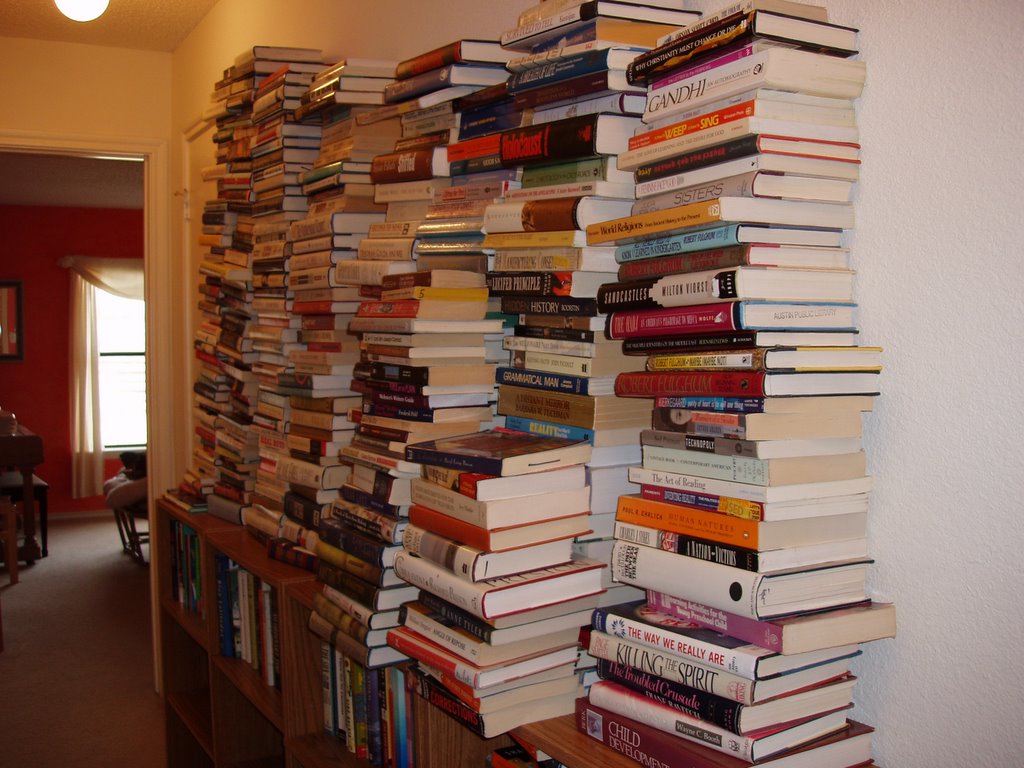
So I'm not sure what precisely happened, but in a moment last night, I went from a person who wouldn't think of parting with a book that I had read to someone who wanted nothing more than a drastic purging of any and every book that didn't justify its inch of shelf space. The picture is of all the books that are outta here. Here's a list of titles on their way out the door; some I've blogged on and some I haven't:

Can You Trust a Tomato in January?

Spoiled: Why Our Food Is Making Us Sick and What We Can Do about It

Why Does Popcorn Pop?

Beyond Beef: The Rise and Fall of the Cattle Culture

Secret Formula

Fat of the Land

Comfort Me with Apples: More Adventures at the Table

Culture of Complaint: The Fraying of America

Consumed: Why Americans Love, Hate, and Fear Food

How to Read a French Fry and Other Stories of Intriguing Kitchen Science

The Tummy Trilogy: American Fried, Alice, Let's Eat, and Third Helpings

Satisfaction Guaranteed: The Making of the American Mass Market

Pot on the Fire: Further Exploits of a Renegade Cook

The Last Days of Haute Cuisine: America's Culinary Revolution

The Clustered World: How We Live, What We Buy, and What It all Means about Who We are

Beard on Food

365 Good Reasons to Be a Vegetarian

Waste and Want: A Social History of Trash

Consuming Culture: Why You Eat What You Eat

Much Depends on Dinner

We Are What We Eat: Ethnic Food and the Making of Americans

Eat, Drink, and Be Merry

Never Satisfied: A Cultural History of Diets, Fantasies, and Fat

The Best Thing I Ever Tasted: The Secret of Food

The Greatest Generation

True Women

Kennedy

'Tis

Home Fires: An Intimate Portrait of One Middle-Class Family in Postwar America

Baghdad without a Map and Other Misadventures in Arabia

A History of Reading

The Book on the Bookshelf

A Place for Us: Eleni's Children in America

Cane River

Real Boys: Rescuing Our Sons from the Myths of Boyhood

Amazing Grace: The Lives of Children and the Conscience of a Nation

Rethinking Schools: An Agenda for Change

Ghosts from the Nursery: Tracing the Roots of Violence

Punished by Rewards

The Trouble with Perfect

New Mother's Guide to Breastfeeding

Minding the Children: Child Care in America from Colonial Times to the Present

Battleground: One Mother's Crusade, The Religious Right, and the Struggle for Our Schools

Childwise

The Shelter of Each Other

Saving Childhood: Protecting our Children from the National Assault on Innocence

Failure to Connect: How Computers Affect Our Children's Minds--and What We Can Do about It

The Closing of the American Mind

Marriage and Family in a Changing Society

There Are No Children Here: The Story of Two Boys Growing Up in the Other America

Child Development

The Vocation of a Teacher

The Troubled Crusade: American Education 1945-1980

Killing the Spirit: Higher Education in America

The Way We Really Are: Coming to Terms with America's Changing Families

Learning Activities for the Young Preschool Child

The Path Between the Seas

The Fatal Shore: The Epic of Australia's Founding

Reading Lolita in Tehran: A Memoir in Books

A Renaissance Tapestry: The Gonzaga of Mantua

The Kindness of Strangers: The Abandonement of Children in Western Europe

Prodigal Summer

Traveling Mercies: Some Thoughts on Faith

Not All of Us Are Saints: A Doctor's Journey with the Poor

The African Experience

Lost Worlds: How Our European Ancestors Coped with Everyday Life and Why Life Is So Hard Today

A Geography of Time: The Temporal Misadventures of a Social Psychologist

Levitating Trains and Kamikaze Genes

Living Out Loud

A Not Entirely Beniegn Procedure: Four Years As a Medical Student

Good Wives: Image and Reality iin the Lives of Women in Northern New England, 1650-1750

Wide Awake at 3:00am: By Choice or By Chance?

The Concise Dictionary of English Etymology

A Map of the World

The Lexus and the Olive Tree

365 TV-Free Activities You Can Do With Your Child

365 Outdoor Activities You Can Do With Your Child

The Twentieth Century: The History of the World: 1901 to 2000

A Civil Action

A Woman in Residence: A Doctor's Personal and Professional Battle Against An Insensitive Medical System

Operating Instructions: A Journal of My Son's First Year

Rubbish: The Archaeology of Garbage

September

The Act of Reading: A Theory of Aesthetic Response

The Vintage Book of Contemporary American Poetry

Technopoly: The Surrender of Culture to Technology

Memoirs of a Geisha

Inventing Reality: The Politics of News Media

Purity of the Heart Is to Will One Thing

How Does Aspirin Find a Headache?

Extraordinary Popular Delusions and the Madness of Crowds

The Pilot's Wife

Manufacturing Victims

Villages

The Mother Tongue: English and How It Got That Way

Homeward Bound: American Families in the Cold War Era

A Nation of Victims: The Decay of the American Character

Human Natures: Genes; Cultures, and the Human Prospect

In Love with Norma Loquendi

The Girl from Botany Bay

Christmas Portraits

The Bible Code

When I Am an Old Woman I Shall Wear Purplse

An Introduction to Language

Low Fat Cooking

Chicken Soup for the Mother's Soul

Reality Isn't What It Used to Be

A Distant Mirror

Grammatical Man

Keeping Faith

The Millionare Next Door

The Professor and the Madman

The Girl with the Pearl Earring

Hidden History: Exploring Our Secret Past

The Lucifer Principle: A Scientific Expedition into the Forces of History

Manufacturing Consent: The Political Economy of the Mass Media

The Heath Anthology of American Literature

The Seven Storey Mountain

The View from a Monestary

The Inquisition: Hammer of Heresy

Why God Became Man and The Virgin Conception and Original Sin

The Birth of Christianity: Reality and Myth

The Cloister Walk

Christology in Dialogue

The Gospel of Mark

A World Full of Gods: The Strange Triumph of Christianity

The Way of Jesus Christ

Jesus, the Crucified People

Catch-22

The Lion, the Witch, and the Wardrobe

The Gay Science with a Prelude in Rhymes

Les Miserables

King Lear

Plagues and People

The Color Purple

Fried Green Tomatoes at the Whistle-Stop Cafe

A Woman's Journey to God

The Bad Popes

Jesus in Contemporary Scholarship

Why Christianity Must Change or Die

Dictionary of Saints

Christology at the Crossroads

Meditations on the Apocalype

The Letter to the Hebrews

Crossing the Threshhold of Hope

Everyday Life in Ancient Times

The Holocaust

A Breath of Life: Feminism in the American Jewish Community

Jewish Memories

Tradition in A Rootless World: Women Turn to Orthodox Judaism

The Folk of the Fringe

Gandhi: An Autobiography

Medieval Women's Visionary Literature

Communion: Contemporary Writers Reveal the Bible in Their Lives

In Whose Image? God and Gender

A Time to Weep, A Time to Sing: Faith Journies of Women Scholars of Religion

The Love of Learning and the Desire for God: A Study of Monastic Culture

Sisters: Lives of Devotion and Defiance

The Feminine Face of God: The Unfolding of the Sacred in Women

Beyond God the Father: Toward a Philosophy of Women's Liberation

It Was on Fire When I Lay Down on It

All I Really Needed to Know I Learned in Kindergarten

World Religions from Ancient History to the Present

Sandcastles: The Arabs In Search of the Modern World

Hadj: An American's Pilgrimage to Mecca

The Multiple Identities of the Middle East

Maybe (Maybe Not)

From Beginning to End: The Rituals of Our Lives

The Second Stage

Stiffed: The Betrayal of the American Man

Fire with Fire: The New Female Power and How It Will Change the 21st Century

Second to None: A Documentary History of American Women

A History of Their Own: Women In Europe

Deborah, Golda, and Me: Being Female and Jewish in America

Generations: A Century of Women Speak about Their Lives

Home-Alone America: The Hidden Tole of Day Care, Behavorial Drugs, and Other Parent Substitutes

The Women's Room

Women and Men in Society

Issues in Feminism: An Introduction to Women's Studies

Women of Ideas (and What Men Have Done to Them)

The World Split Open: How the Modern Women's Movement Changed America

Women's Roots

The Women's History of the World

Lifting the Veil: The Feminine Face of Science

Women of the Four Winds: The Adventures of Four of America's First Women Explorers

The Underside of History Volume I

The Underside of History Volume II

Gyn/Ecology: The Metaethics of Radical Feminism

The Mismeasure of Woman: Why Women Are Not the Better Sex, the Inferior Sex, or the Opposite Sex

Sex, Art, and American Culture

The Psychology of Women

Women at Work

Woman's Creation: Sexual Evolution and the Shaping of Society

Women of the Forest

Brave New Families: Stories of Domestic Upheaval in late 20C America

Misdiagnosis: Woman As A Disease

The Mask of Motherhood: How Becoming a Mother Changes Our Lives and Why We Never Talk about It

A Life's Work: On Becoming a Mother

American Mom: Motherhood, Politics, and Humble Pie

Food and Whine: Confessions of an End of the Millennium Mom

Fruitful: A Real Mother in the Modern World

Mothers Talking: Sharing the Secret

Spin Sisters: How the Women of the Media Sell Unhappiness--and Liberalism--the the Women of America

The War Against Boys: How Misguided Feminism is Harming Our Young Men

Ever Since Adam and Eve

Misconceptions: Truth, Lies, and the Unexpected on the Journey to Motherhood

What's a Smart Woman Like You Doing at Home?

Mother Journeys: Feminist Write about Mothering

Ever Since Eve: Personal Reflections on Childbirth

The American Way of Birth

Mothers and Such: Views of American Women and Why They Changed

The Motherhood Report: How Women Feel about Being Mothers

The Price of Motherhood: Why the Most Important Job in the World Is Still the Least Valued

Good Enough Mother: Changing Expectations for Ourselves

Margaret Sanger and the American Birth Control Movement

Sam Walton: Made in America

The Girl from Purple Mountain: Love, Honor, War, and One Family's Journey from China to America

Waiting: True Confessions of a Waitress

Lady Bird: A Biography of Mrs. Johnson

Blue Sky Dream: A Memoir of America's Fall from Grace

21 Dog Years: Doing Time at Amazon.com

Not by the Sword: How the Love of a Cantor and His Family Transformed a Klansman

M.D.: One Doctor's Adventures Among the Famour and Infamous from the Jungles of Panama to a Park Avenue Practice

Founding Mothers: The Women Who Raised Our Nation

Straight from the Heart: My Life in Politics and Other Places (Ann Richards)

A Reporter's Life (Walter Cronkite)

Not Without My Daughter: A True Story

Princess: A True Story of Life Behind the Veil in Saudi Arabia

Zoya's Story: An Afghan Woman's Struggle for Freedom

My Forbidden Face: Growing Up Under the Taliban: A Young Woman's Story

A Bomb in the Brain: A Heroic Tale of Science, Surgery, and Survival

Trial by Fire: A Woman Correspondent's Journey to the Frontline

A Girl Named Zippy: Growing Up Small in Mooreland, Indiana

The Dark Side of Camelot

Washington: The Indispensible Man

Mornings on Horseback

A Hope in the Unseen: An American Odyssey from the Inner City to the Ivy League

Seven from Heaven: The Miracle of the McCaughy Septuplets

Galileo's Daugher: A Historical Memoir of Science, Faith, and Love

Abraham Lincoln

The Hungry Ocean: A Swordboat Captain's Journey

Great Harry

Her Little Majesty: The Life of Queen Victoria

Lilibet: An Intimate Portrait of Elizabeth II

Storytelling with the Flannel Board

Ronald Reagan: An American Life

House of Sand and Fog

A Walk in the Woods

The Birth of Venus

The Known World

The Emperor of Scent

A Crack in the Edge of the World: America and the Great California Earthquake of 1906

What Einstein Told His Cook Volume II

Plain Speaking: A Candid and Revealing Portrait of the 33rd President in His Own Voice

Mary Queen of Scotland and the Isles

Food Fight: The Inside Story of the Food Industry, America's Obesity Crisis, and What We Can Do about It

From Sundails to Atomic Clocks

One Hundred Days: My Unexpected Journey from Doctor to Patient

Ether Day: The Strange Tale of America's Greatest Medical Discovery and the Haunted Men Who Made It

The Measure of All Things: The Seven-Year Odyssey and Hidden Error That Transformed the World

Entwined Lives: Twins and What They Tell Us About Human Behavior

A Natural History of the Senses

In a House of Dreams and Glass: Becoming a Psychiatrist

The God Particle: If the Universe Is the Answer: What Is the Question?

The Mind of God: The Scientific Basis for a Rational World

Dreams of a Final Theory: The Search for the Fundamental Laws of Nature

The Medicine of ER or How We Almost Die

The Physics of Star Trek

The Secret Life of Germs: Observations and Lessons from a Microbe Hunter

How We Die: Reflections on Life's Final Chapter

First, Do No Harm: The Dramatic Story of Real Doctors and Patients Making Impossible Choices at a Big-City Hospital

Why We Get Sick: The New Theory of Darwinian Medicine

The Copernican Revolution: Planetary Astronomy and the Development of Western Thought

Why Things Bite Back: Technology and the Revenge of Unintended Consequences

The Stone Age Present: How Evolution Shapes Modern Life

Paradigms Lost: Images of Man in the Mirror of Science

Exploding the Gene Myth

Leprosy: Diagnosis and Management

Discoveries and Opinions of Galileo

Doctors: The Biography of Medicine

Nobel Prize Women in Science

The First Three Minutes: A Modern View of the Origin of the Universe

Myths, Models, and Paradigms

The Birth of a New Physics

Medicine at the Crossroads

The Selfish Gene

The Construction of Modern Science

The Cosmic Blueprint

The Scientific Background to Modern Philosophy

The Medical Detectives

Empires of Time: Calendars, Clocks, and Culture

Fuzzy Thinking: The New Science of Fuzzy Logic

Virus X: Tracking the New Killer Plague

The Brethren

The Lazarus Child

The Nanny Diaries

The Bonesetter's Daughter

Drowning Ruth

The Voyage of the Narwhal

The Corrections

The Stone Diaries

Bridget Jones' Diary

The Curious Incidnet of the Dog in the Nighttime

Angle of Repose

Back When We Were Grownups

A Perfect Arrangement

The Cobra Event

Paper Trail

Seeing Calvin Coolidge in a Dream

Little Altars Everywhere

Midwives

Holidays in Hell

Parliament of Whores

Age and Guile Beat Youth, Innocence, and a Bad Haircut

Give War a Chance

Slaves in the Family

Shadows and Wind: A View of Modern Vietnam

The Lost Tribe: A Harrowing Passage Into New Guinea's Heart of Darkness

Family Man

Faster: The Acceleration of Just About Everything

Never Done: A History of American Housework

Out of Silence: A Journey into Language

The Search for the Perfect Language

Middletown, America: One Town's Passage from Trauma to Hope

The Middle of Everywhere: Helping Refugees Enter the American Community

Bias: A CBS Insider Exposes How the Media Distort the News

I Want That! How We All Became Shoppers

The Myth of the Welfare Queen

Why We Buy: The Science of Shupping

Feasting the Heart: 52 Commentaries for the Air

Alpha Beta: How 26 Letters Shaped the Western World

A World of Their Own Making: Myth, Ritual, and the Quest for Family Values

Fearless: Real Truth about Risk, Safety, and Security in a Time of Terrorism

The 9/11 Commission Report

Four Arguments for the Elimination of Television

Around the Bloc: My Life in Moscow, Beijing, and Havana

The Rest of Us: Dispatches from the Mother Ship

Calendar: Humanity's Struggle to Determine a True and Accurate Year

Walden

The Great Gatsby

Of Mice and Men and Cannery Row

The Grapes of Wrath

East of Eden

I Know Why the Caged Bird Sings

Roots

Surely You're Joking, Mr. Feynman!

The Physics of Star Trek

The Ships of Earth

Cultural Anthropology

The Changling

Survived to Tell: An Autobiography

Blog Archive