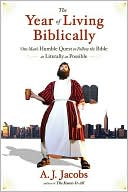
 Jacobs, who described himself as being Jewish in the same way that The Olive Garden is Italian, spends a year trying to live, as literally as possible, every commandment in the Bible. He also visits fundamentalists of various stripes throughout the year. The results are hilarious and thought-provoking. Highly recommended.
Sunday, October 14, 2007
The Year of Living Biblically by A. J. Jacobs
Jacobs, who described himself as being Jewish in the same way that The Olive Garden is Italian, spends a year trying to live, as literally as possible, every commandment in the Bible. He also visits fundamentalists of various stripes throughout the year. The results are hilarious and thought-provoking. Highly recommended.

Wednesday, October 10, 2007
Well-Behaved Women Seldom Make History by Laurel Thatcher Ulrich
 Laurel Thatcher Ulrich is my hero and I don't say that lightly. This book is way fun. Her other works have taken a small slice of life and looked in-depth (anyone who hasn't read A Midwife's Tale needs to stop what they are doing right now and go read it), but this book covers the entire enchilada. What is most fun about this book is that instead of plodding along chronologically, she works thematically. This book will, I'm sure, become a standard text for intro to Women's History and similar classes. And it should be. But it is also buckets of fun and would be a great choice for a high-school aged homeschooler.
Saturday, October 06, 2007
The Arms of His Love: Talks from the 1999 Women's Conference
Years ago, I loved the Women's Conference books. Now, they barely hold my interest. I'm not sure if the books have changed or I have. Maybe both.
Thursday, September 27, 2007
The Zookeeper's Wife by Diane Ackerman
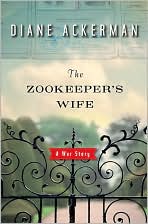
A charming tale of a Polish woman who hid Jews in her zoo. The gentle humor of a life surrounded by animals nicely balances the terrors of Nazi occupation. Recommended.
Wednesday, September 19, 2007
Setting the Record Straight: Blacks and the Mormon Priesthood by Marcus H. Martins
Millennial Press has a new series of short books on controversial topics. The volume on the priesthood ban was written by Marcus H. Martins, a Brazilian who joined the church in 1972 and would later be the first post-1978 full-time missionary of African descent. He speaks with a faithful voice; he's the chair of the Department of Religious Education at BYU-Hawaii. 
The best parts of the book are his personal experiences with living the gospel as a man of African descent both before and after 1978. He related that he is often asked why his family joined a church that didn't allow them to take part in the priesthood. His heartbreaking but perfect response, based on John 6:67-69: "We had nowhere else to go."
But most of the book is, as the back cover puts it, "deeply doctrinal" and not personal. This causes a problem as all one can say with surety about the priesthood ban is this:
(1) We don't know the reason for the ban.
(2) Everything you've ever heard justifying the ban was Mormon folklore and should be ignored; see statements from Elder McConkie and, more recently, Elder Oaks to support this idea.
So Martins says those things. But that isn't enough to make a book, not even one that's a slim 83 pages. What Martins adds often feels like filler and in some cases detracts from his overall message. For example, at one point he makes the argument that the ban wasn't an eternal law, but a custom. He uses a system of classifying laws in order to make this point. Unfortunately, this leads him into unnecessary and bizarre conjecture ("We may assume that electromagnetism and perhaps even the weak and strong nuclear forces might also be controlled by the Holy Ghost.")
He spends some time logically (and scripturally) debunking the more common folk doctrine. And his arguments are pretty good, but they miss the main point: the purveyors of the folklore he is disputing were people sustained as prophets, seers, and revelators. So logical arguments are all well and good, but the real issue is the authority with which the person spoke when making the statement. But Martins doesn't address how problematic it is when he is saying (in effect, because he doesn't name names): "This argument, made by Joseph Fielding Smith or Bruce R. McConkie, is incorrect because it is not scriptural." This, of course, leads to a larger question (that Martins doesn't address): If previous church leaders were guilty of promulgating folklore to explain practice, then could current leaders be doing the same? How does this knowledge of the past affect how we view the present? These may be some of the most troubling questions related to the priesthood ban for twenty-first century Mormons and so it is disappointing not to see them addressed here.
While I'm no expert on the history of the priesthood ban, there were a few statements Martins made that caught me short. In one case, he referred to "the Prophet Joseph Smith's opposition to the ordination of Blacks." But my understanding is that there is no scholarly consensus as to the origin of the ban and that many scholars locate it in the time of Brigham Young, especially since Joseph Smith ordained Elijah Abel, a black man. Martins also seems unaware of the material in the recent biography of President McKay, which contains statements that contradict his assertions that "the Lord appears to have been mostly silent about the issue until June 1, 1978" and that "the leaders of the past had already discussed the matter, and that because they had no ideas of their own to add, they didn't see any need for further discussion." (This latter statement is also contradicted by the efforts of J. Reuben Clark as described in Quinn's biography of Clark.) It is also unfortunate that Martins uses Acts 10:15 to sum up the section where he argues that the Lord only revealed the end of the ban when Church leaders showed interest in it, since the scripture from Acts shows the Lord ending a similar ban (i.e., on eating with Gentiles) that was most certainly not requested by the prophet at the time.
Despite these flaws, I am pleased that Millennial Press has issued this series of books and pleased with Martins' presentation of the issue in general.
Cross-posted from Times & Seasons
The best parts of the book are his personal experiences with living the gospel as a man of African descent both before and after 1978. He related that he is often asked why his family joined a church that didn't allow them to take part in the priesthood. His heartbreaking but perfect response, based on John 6:67-69: "We had nowhere else to go."
But most of the book is, as the back cover puts it, "deeply doctrinal" and not personal. This causes a problem as all one can say with surety about the priesthood ban is this:
(1) We don't know the reason for the ban.
(2) Everything you've ever heard justifying the ban was Mormon folklore and should be ignored; see statements from Elder McConkie and, more recently, Elder Oaks to support this idea.
So Martins says those things. But that isn't enough to make a book, not even one that's a slim 83 pages. What Martins adds often feels like filler and in some cases detracts from his overall message. For example, at one point he makes the argument that the ban wasn't an eternal law, but a custom. He uses a system of classifying laws in order to make this point. Unfortunately, this leads him into unnecessary and bizarre conjecture ("We may assume that electromagnetism and perhaps even the weak and strong nuclear forces might also be controlled by the Holy Ghost.")
He spends some time logically (and scripturally) debunking the more common folk doctrine. And his arguments are pretty good, but they miss the main point: the purveyors of the folklore he is disputing were people sustained as prophets, seers, and revelators. So logical arguments are all well and good, but the real issue is the authority with which the person spoke when making the statement. But Martins doesn't address how problematic it is when he is saying (in effect, because he doesn't name names): "This argument, made by Joseph Fielding Smith or Bruce R. McConkie, is incorrect because it is not scriptural." This, of course, leads to a larger question (that Martins doesn't address): If previous church leaders were guilty of promulgating folklore to explain practice, then could current leaders be doing the same? How does this knowledge of the past affect how we view the present? These may be some of the most troubling questions related to the priesthood ban for twenty-first century Mormons and so it is disappointing not to see them addressed here.
While I'm no expert on the history of the priesthood ban, there were a few statements Martins made that caught me short. In one case, he referred to "the Prophet Joseph Smith's opposition to the ordination of Blacks." But my understanding is that there is no scholarly consensus as to the origin of the ban and that many scholars locate it in the time of Brigham Young, especially since Joseph Smith ordained Elijah Abel, a black man. Martins also seems unaware of the material in the recent biography of President McKay, which contains statements that contradict his assertions that "the Lord appears to have been mostly silent about the issue until June 1, 1978" and that "the leaders of the past had already discussed the matter, and that because they had no ideas of their own to add, they didn't see any need for further discussion." (This latter statement is also contradicted by the efforts of J. Reuben Clark as described in Quinn's biography of Clark.) It is also unfortunate that Martins uses Acts 10:15 to sum up the section where he argues that the Lord only revealed the end of the ban when Church leaders showed interest in it, since the scripture from Acts shows the Lord ending a similar ban (i.e., on eating with Gentiles) that was most certainly not requested by the prophet at the time.
Despite these flaws, I am pleased that Millennial Press has issued this series of books and pleased with Martins' presentation of the issue in general.
Cross-posted from Times & Seasons
Body of Work by Christine Montross
 A mildly interesting memoir of the author's experience dissecting a human body as a first-year med student. A better book on this topic is Mary Roach's Stiff.
Saturday, September 15, 2007
Elder Statesman: A Biography of J. Reuben Clark by D. Michael Quinn
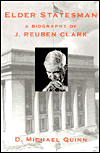 Good stuff, but definitely not for the faint of heart. Reading a book like this with its cringe-inducing GA squabbles, errors, and extremely bizarre personal opinions taught over the pulpit is almost enough to make one a believer in 'faithful history.' Clark certainly was an odd duck.
Tuesday, September 11, 2007
On the Road with Joseph Smith by Richard Bushman
 I can't remember that last time I enjoyed reading a book this much (and I'm not just saying that because my name was on page 78). This is essentially Bushman's diary from the year after Rough Stone Rolling was published and he muses on everything from sales rank at Amazon to the deeper issues of non-member perception of Joseph Smith. There's a blog post on nearly every page of this book--it is that discussion-worthy. Highly recommended.
Last Harvest by Witold Rybczynski
 This was interesting: he traced every step in the development of a new neighborhood.
Monday, September 10, 2007
Ice Bound by Jerri Lynn Nielsen
 I thought this was be a fairly tame "here's my 15 minutes of fame!" sort of book but I thought it was fascinating.
A Class Apart: Prodigies, Pressure and Passion Inside One of America's Best High Schools by Alec Klein
 This was mildly interesting. The pressure these kids are under is amazing and saddening. I admit that I was reading looking for secrets to the production of super-students. Unfortunately, the only thing I came away with was: "Start with a kid already internally motivated or convince them that you won't love them and/or will punish them if they don't excel."
No thanks.
Saturday, September 01, 2007
Mara, Daughter of the Nile by Eloise Jarvis McGraw
 Ooh, this was good--I was prereading it since I'll be having my 9yo read it for school this year. Books like this make me glad that I'm a homeschooler! The story was engaging, the background (ancient Egypt) was fabulous, and I thought Mara was the perfect feminist heroine--even allowed a love story, but noted for her bravery and self-defense. Do not be put off by the cheesy 80s cover art! Highly recommended for adults and kids--would be a great read-aloud.
Thursday, August 30, 2007
Stuffed: Adventures of a Restaurant Family by Patricia Volk
 So disappointing--it was about as interesting as reading someone else's family history.
Wednesday, August 29, 2007
The World Without Us by Alan Weisman
 Completely entertaining and filled with all manner of interesting tidbits, Weisman's book does justice to its unique topic. It didn't fall down until the last few pages where he suggests a world-wide single child policy as a miracle cure for all of the world's environmental problems. That's too clever by half, but the rest of the book is great.
Friday, August 24, 2007
A Thousand Splendid Suns by Khaled Hosseini
 So, so hard to read--even novelized, you know the tragedies lived by the Afghani people aren't fiction. But such an excellent, gripping book with love and redemption on every page.
Thursday, August 23, 2007
FDR by Jean Edward Smith
 Good but not great. Possibly my fault since I've read several others books skirting the subject and so there wasn't a whole lot new here. But a few interesting tidbits.
Friday, August 10, 2007

Tuesday, August 07, 2007
The Spirit Catches You and You Fall Down by Anne Fadiman
 Easily one of the ten best books that I have ever read, this exploration into the experiences of Hmong immigrants with the American health care system shone a revealing light on both. Highly, highly recommended.
Thursday, August 02, 2007
Head Start with the Book of Mormon by Vicki Lynn Rasmussen

When I think about the curricula available to evangelical homeschoolers, I instantly become guilty of several of the deadly sins. Oh, if I were a young earth creationist, the riches that would be mine!
Lipstick Jihad by Azadeh Moaveni
 This was a pretty good mix of personal and political reflections on life in Iran and the challenges of being bicultural.
Subscribe to:
Posts (Atom)