Sunday, March 26, 2006

Things in Heaven and Earth: The Life and Times of Wilford Woodruff by Thomas G. Alexander

Perhaps after last year's amazing biographies of Joseph Smith, David O. McKay, and Spencer W. Kimball, the bar has been set a little too high. All the same, this book had a definite Eat Your Vegetables feel to it; I trudged through but I didn't much like it.

Saturday, March 18, 2006

Who Stole Feminism? by Christina Hoff Sommers


One way of teaching the writing and editing process is called The Mad Hatter. The student is told that the writer wears four different hats: the mad (wo)man, the architect, the builder, and the janitor. The problem with this book is that Sommers never made it past the first hat. There is great raw material here (including evidence to rebunk virtually everything you heard in the mainstream media about the status of women and girls in the last decade) but Sommers zings from topic to topic without context, transition, summation, or, you know, actually developing a thesis. Which is a real shame because the ideas in this book are important.

Sunday, March 12, 2006

The Kite Runner by Khaled Hosseini


This book was tremendous--one of the best novels that I have ever read. Perhaps I should have been rolling my eyes at all of the coincidences that were necessary to move the plot along, but for some reason I didn't. The story hung together nicely and just seemed right. Highly recommended.

Friday, March 10, 2006

Raising America by Ann Hulbert

I'd been looking forward to reading this book for months; unfortunately, it was boring beyond belief. I gave up after just a few pages.

The Children's Blizzard by David Laskin


I need a neologism: it would describe the genre where one incident is used as a window to open a variety of topics. In this case, a blizzard in 1888 that killed hundreds of schoolchildren (the weather shifted abruptly in the middle of a school day, forcing children to walk home in light clothing) is used as the point of departure for an exploration of immigration to the Great Plains, meteorology, and the physical effects of freezing weather. All of these are interesting; Laskin's only misstep is spending too much bandwidth on century-old political infighting among government weather forcasters. But on balance, this was a very interesting--if heartbreaking--book.

Sunday, March 05, 2006

Parasite Rex

You know, the ick factor on this book wasn't nearly as high as I had expected, yet it was full of fascinating tidbits about parasites. Highly recommended.

Saturday, March 04, 2006

Thinning the Herd


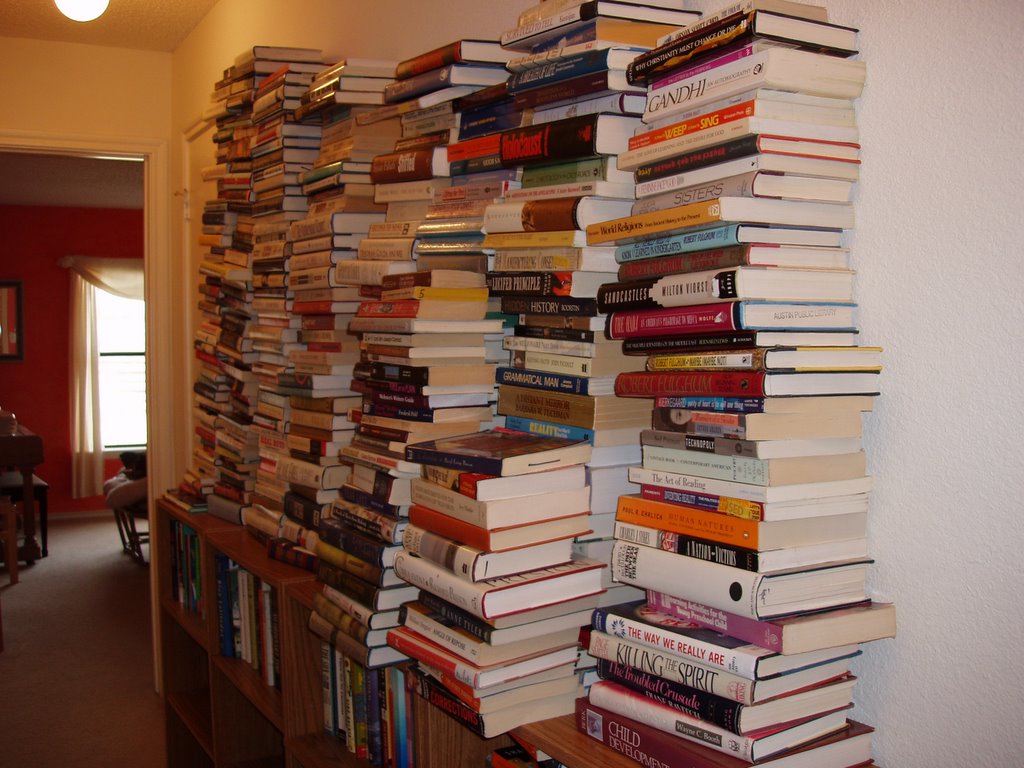
So I'm not sure what precisely happened, but in a moment last night, I went from a person who wouldn't think of parting with a book that I had read to someone who wanted nothing more than a drastic purging of any and every book that didn't justify its inch of shelf space. The picture is of all the books that are outta here. Here's a list of titles on their way out the door; some I've blogged on and some I haven't:

Can You Trust a Tomato in January?

Spoiled: Why Our Food Is Making Us Sick and What We Can Do about It

Why Does Popcorn Pop?

Beyond Beef: The Rise and Fall of the Cattle Culture

Secret Formula

Fat of the Land

Comfort Me with Apples: More Adventures at the Table

Culture of Complaint: The Fraying of America

Consumed: Why Americans Love, Hate, and Fear Food

How to Read a French Fry and Other Stories of Intriguing Kitchen Science

The Tummy Trilogy: American Fried, Alice, Let's Eat, and Third Helpings

Satisfaction Guaranteed: The Making of the American Mass Market

Pot on the Fire: Further Exploits of a Renegade Cook

The Last Days of Haute Cuisine: America's Culinary Revolution

The Clustered World: How We Live, What We Buy, and What It all Means about Who We are

Beard on Food

365 Good Reasons to Be a Vegetarian

Waste and Want: A Social History of Trash

Consuming Culture: Why You Eat What You Eat

Much Depends on Dinner

We Are What We Eat: Ethnic Food and the Making of Americans

Eat, Drink, and Be Merry

Never Satisfied: A Cultural History of Diets, Fantasies, and Fat

The Best Thing I Ever Tasted: The Secret of Food

The Greatest Generation

True Women

Kennedy

'Tis

Home Fires: An Intimate Portrait of One Middle-Class Family in Postwar America

Baghdad without a Map and Other Misadventures in Arabia

A History of Reading

The Book on the Bookshelf

A Place for Us: Eleni's Children in America

Cane River

Real Boys: Rescuing Our Sons from the Myths of Boyhood

Amazing Grace: The Lives of Children and the Conscience of a Nation

Rethinking Schools: An Agenda for Change

Ghosts from the Nursery: Tracing the Roots of Violence

Punished by Rewards

The Trouble with Perfect

New Mother's Guide to Breastfeeding

Minding the Children: Child Care in America from Colonial Times to the Present

Battleground: One Mother's Crusade, The Religious Right, and the Struggle for Our Schools

Childwise

The Shelter of Each Other

Saving Childhood: Protecting our Children from the National Assault on Innocence

Failure to Connect: How Computers Affect Our Children's Minds--and What We Can Do about It

The Closing of the American Mind

Marriage and Family in a Changing Society

There Are No Children Here: The Story of Two Boys Growing Up in the Other America

Child Development

The Vocation of a Teacher

The Troubled Crusade: American Education 1945-1980

Killing the Spirit: Higher Education in America

The Way We Really Are: Coming to Terms with America's Changing Families

Learning Activities for the Young Preschool Child

The Path Between the Seas

The Fatal Shore: The Epic of Australia's Founding

Reading Lolita in Tehran: A Memoir in Books

A Renaissance Tapestry: The Gonzaga of Mantua

The Kindness of Strangers: The Abandonement of Children in Western Europe

Prodigal Summer

Traveling Mercies: Some Thoughts on Faith

Not All of Us Are Saints: A Doctor's Journey with the Poor

The African Experience

Lost Worlds: How Our European Ancestors Coped with Everyday Life and Why Life Is So Hard Today

A Geography of Time: The Temporal Misadventures of a Social Psychologist

Levitating Trains and Kamikaze Genes

Living Out Loud

A Not Entirely Beniegn Procedure: Four Years As a Medical Student

Good Wives: Image and Reality iin the Lives of Women in Northern New England, 1650-1750

Wide Awake at 3:00am: By Choice or By Chance?

The Concise Dictionary of English Etymology

A Map of the World

The Lexus and the Olive Tree

365 TV-Free Activities You Can Do With Your Child

365 Outdoor Activities You Can Do With Your Child

The Twentieth Century: The History of the World: 1901 to 2000

A Civil Action

A Woman in Residence: A Doctor's Personal and Professional Battle Against An Insensitive Medical System

Operating Instructions: A Journal of My Son's First Year

Rubbish: The Archaeology of Garbage

September

The Act of Reading: A Theory of Aesthetic Response

The Vintage Book of Contemporary American Poetry

Technopoly: The Surrender of Culture to Technology

Memoirs of a Geisha

Inventing Reality: The Politics of News Media

Purity of the Heart Is to Will One Thing

How Does Aspirin Find a Headache?

Extraordinary Popular Delusions and the Madness of Crowds

The Pilot's Wife

Manufacturing Victims

Villages

The Mother Tongue: English and How It Got That Way

Homeward Bound: American Families in the Cold War Era

A Nation of Victims: The Decay of the American Character

Human Natures: Genes; Cultures, and the Human Prospect

In Love with Norma Loquendi

The Girl from Botany Bay

Christmas Portraits

The Bible Code

When I Am an Old Woman I Shall Wear Purplse

An Introduction to Language

Low Fat Cooking

Chicken Soup for the Mother's Soul

Reality Isn't What It Used to Be

A Distant Mirror

Grammatical Man

Keeping Faith

The Millionare Next Door

The Professor and the Madman

The Girl with the Pearl Earring

Hidden History: Exploring Our Secret Past

The Lucifer Principle: A Scientific Expedition into the Forces of History

Manufacturing Consent: The Political Economy of the Mass Media

The Heath Anthology of American Literature

The Seven Storey Mountain

The View from a Monestary

The Inquisition: Hammer of Heresy

Why God Became Man and The Virgin Conception and Original Sin

The Birth of Christianity: Reality and Myth

The Cloister Walk

Christology in Dialogue

The Gospel of Mark

A World Full of Gods: The Strange Triumph of Christianity

The Way of Jesus Christ

Jesus, the Crucified People

Catch-22

The Lion, the Witch, and the Wardrobe

The Gay Science with a Prelude in Rhymes

Les Miserables

King Lear

Plagues and People

The Color Purple

Fried Green Tomatoes at the Whistle-Stop Cafe

A Woman's Journey to God

The Bad Popes

Jesus in Contemporary Scholarship

Why Christianity Must Change or Die

Dictionary of Saints

Christology at the Crossroads

Meditations on the Apocalype

The Letter to the Hebrews

Crossing the Threshhold of Hope

Everyday Life in Ancient Times

The Holocaust

A Breath of Life: Feminism in the American Jewish Community

Jewish Memories

Tradition in A Rootless World: Women Turn to Orthodox Judaism

The Folk of the Fringe

Gandhi: An Autobiography

Medieval Women's Visionary Literature

Communion: Contemporary Writers Reveal the Bible in Their Lives

In Whose Image? God and Gender

A Time to Weep, A Time to Sing: Faith Journies of Women Scholars of Religion

The Love of Learning and the Desire for God: A Study of Monastic Culture

Sisters: Lives of Devotion and Defiance

The Feminine Face of God: The Unfolding of the Sacred in Women

Beyond God the Father: Toward a Philosophy of Women's Liberation

It Was on Fire When I Lay Down on It

All I Really Needed to Know I Learned in Kindergarten

World Religions from Ancient History to the Present

Sandcastles: The Arabs In Search of the Modern World

Hadj: An American's Pilgrimage to Mecca

The Multiple Identities of the Middle East

Maybe (Maybe Not)

From Beginning to End: The Rituals of Our Lives

The Second Stage

Stiffed: The Betrayal of the American Man

Fire with Fire: The New Female Power and How It Will Change the 21st Century

Second to None: A Documentary History of American Women

A History of Their Own: Women In Europe

Deborah, Golda, and Me: Being Female and Jewish in America

Generations: A Century of Women Speak about Their Lives

Home-Alone America: The Hidden Tole of Day Care, Behavorial Drugs, and Other Parent Substitutes

The Women's Room

Women and Men in Society

Issues in Feminism: An Introduction to Women's Studies

Women of Ideas (and What Men Have Done to Them)

The World Split Open: How the Modern Women's Movement Changed America

Women's Roots

The Women's History of the World

Lifting the Veil: The Feminine Face of Science

Women of the Four Winds: The Adventures of Four of America's First Women Explorers

The Underside of History Volume I

The Underside of History Volume II

Gyn/Ecology: The Metaethics of Radical Feminism

The Mismeasure of Woman: Why Women Are Not the Better Sex, the Inferior Sex, or the Opposite Sex

Sex, Art, and American Culture

The Psychology of Women

Women at Work

Woman's Creation: Sexual Evolution and the Shaping of Society

Women of the Forest

Brave New Families: Stories of Domestic Upheaval in late 20C America

Misdiagnosis: Woman As A Disease

The Mask of Motherhood: How Becoming a Mother Changes Our Lives and Why We Never Talk about It

A Life's Work: On Becoming a Mother

American Mom: Motherhood, Politics, and Humble Pie

Food and Whine: Confessions of an End of the Millennium Mom

Fruitful: A Real Mother in the Modern World

Mothers Talking: Sharing the Secret

Spin Sisters: How the Women of the Media Sell Unhappiness--and Liberalism--the the Women of America

The War Against Boys: How Misguided Feminism is Harming Our Young Men

Ever Since Adam and Eve

Misconceptions: Truth, Lies, and the Unexpected on the Journey to Motherhood

What's a Smart Woman Like You Doing at Home?

Mother Journeys: Feminist Write about Mothering

Ever Since Eve: Personal Reflections on Childbirth

The American Way of Birth

Mothers and Such: Views of American Women and Why They Changed

The Motherhood Report: How Women Feel about Being Mothers

The Price of Motherhood: Why the Most Important Job in the World Is Still the Least Valued

Good Enough Mother: Changing Expectations for Ourselves

Margaret Sanger and the American Birth Control Movement

Sam Walton: Made in America

The Girl from Purple Mountain: Love, Honor, War, and One Family's Journey from China to America

Waiting: True Confessions of a Waitress

Lady Bird: A Biography of Mrs. Johnson

Blue Sky Dream: A Memoir of America's Fall from Grace

21 Dog Years: Doing Time at Amazon.com

Not by the Sword: How the Love of a Cantor and His Family Transformed a Klansman

M.D.: One Doctor's Adventures Among the Famour and Infamous from the Jungles of Panama to a Park Avenue Practice

Founding Mothers: The Women Who Raised Our Nation

Straight from the Heart: My Life in Politics and Other Places (Ann Richards)

A Reporter's Life (Walter Cronkite)

Not Without My Daughter: A True Story

Princess: A True Story of Life Behind the Veil in Saudi Arabia

Zoya's Story: An Afghan Woman's Struggle for Freedom

My Forbidden Face: Growing Up Under the Taliban: A Young Woman's Story

A Bomb in the Brain: A Heroic Tale of Science, Surgery, and Survival

Trial by Fire: A Woman Correspondent's Journey to the Frontline

A Girl Named Zippy: Growing Up Small in Mooreland, Indiana

The Dark Side of Camelot

Washington: The Indispensible Man

Mornings on Horseback

A Hope in the Unseen: An American Odyssey from the Inner City to the Ivy League

Seven from Heaven: The Miracle of the McCaughy Septuplets

Galileo's Daugher: A Historical Memoir of Science, Faith, and Love

Abraham Lincoln

The Hungry Ocean: A Swordboat Captain's Journey

Great Harry

Her Little Majesty: The Life of Queen Victoria

Lilibet: An Intimate Portrait of Elizabeth II

Storytelling with the Flannel Board

Ronald Reagan: An American Life

House of Sand and Fog

A Walk in the Woods

The Birth of Venus

The Known World

The Emperor of Scent

A Crack in the Edge of the World: America and the Great California Earthquake of 1906

What Einstein Told His Cook Volume II

Plain Speaking: A Candid and Revealing Portrait of the 33rd President in His Own Voice

Mary Queen of Scotland and the Isles

Food Fight: The Inside Story of the Food Industry, America's Obesity Crisis, and What We Can Do about It

From Sundails to Atomic Clocks

One Hundred Days: My Unexpected Journey from Doctor to Patient

Ether Day: The Strange Tale of America's Greatest Medical Discovery and the Haunted Men Who Made It

The Measure of All Things: The Seven-Year Odyssey and Hidden Error That Transformed the World

Entwined Lives: Twins and What They Tell Us About Human Behavior

A Natural History of the Senses

In a House of Dreams and Glass: Becoming a Psychiatrist

The God Particle: If the Universe Is the Answer: What Is the Question?

The Mind of God: The Scientific Basis for a Rational World

Dreams of a Final Theory: The Search for the Fundamental Laws of Nature

The Medicine of ER or How We Almost Die

The Physics of Star Trek

The Secret Life of Germs: Observations and Lessons from a Microbe Hunter

How We Die: Reflections on Life's Final Chapter

First, Do No Harm: The Dramatic Story of Real Doctors and Patients Making Impossible Choices at a Big-City Hospital

Why We Get Sick: The New Theory of Darwinian Medicine

The Copernican Revolution: Planetary Astronomy and the Development of Western Thought

Why Things Bite Back: Technology and the Revenge of Unintended Consequences

The Stone Age Present: How Evolution Shapes Modern Life

Paradigms Lost: Images of Man in the Mirror of Science

Exploding the Gene Myth

Leprosy: Diagnosis and Management

Discoveries and Opinions of Galileo

Doctors: The Biography of Medicine

Nobel Prize Women in Science

The First Three Minutes: A Modern View of the Origin of the Universe

Myths, Models, and Paradigms

The Birth of a New Physics

Medicine at the Crossroads

The Selfish Gene

The Construction of Modern Science

The Cosmic Blueprint

The Scientific Background to Modern Philosophy

The Medical Detectives

Empires of Time: Calendars, Clocks, and Culture

Fuzzy Thinking: The New Science of Fuzzy Logic

Virus X: Tracking the New Killer Plague

The Brethren

The Lazarus Child

The Nanny Diaries

The Bonesetter's Daughter

Drowning Ruth

The Voyage of the Narwhal

The Corrections

The Stone Diaries

Bridget Jones' Diary

The Curious Incidnet of the Dog in the Nighttime

Angle of Repose

Back When We Were Grownups

A Perfect Arrangement

The Cobra Event

Paper Trail

Seeing Calvin Coolidge in a Dream

Little Altars Everywhere

Midwives

Holidays in Hell

Parliament of Whores

Age and Guile Beat Youth, Innocence, and a Bad Haircut

Give War a Chance

Slaves in the Family

Shadows and Wind: A View of Modern Vietnam

The Lost Tribe: A Harrowing Passage Into New Guinea's Heart of Darkness

Family Man

Faster: The Acceleration of Just About Everything

Never Done: A History of American Housework

Out of Silence: A Journey into Language

The Search for the Perfect Language

Middletown, America: One Town's Passage from Trauma to Hope

The Middle of Everywhere: Helping Refugees Enter the American Community

Bias: A CBS Insider Exposes How the Media Distort the News

I Want That! How We All Became Shoppers

The Myth of the Welfare Queen

Why We Buy: The Science of Shupping

Feasting the Heart: 52 Commentaries for the Air

Alpha Beta: How 26 Letters Shaped the Western World

A World of Their Own Making: Myth, Ritual, and the Quest for Family Values

Fearless: Real Truth about Risk, Safety, and Security in a Time of Terrorism

The 9/11 Commission Report

Four Arguments for the Elimination of Television

Around the Bloc: My Life in Moscow, Beijing, and Havana

The Rest of Us: Dispatches from the Mother Ship

Calendar: Humanity's Struggle to Determine a True and Accurate Year

Walden

The Great Gatsby

Of Mice and Men and Cannery Row

The Grapes of Wrath

East of Eden

I Know Why the Caged Bird Sings

Roots

Surely You're Joking, Mr. Feynman!

The Physics of Star Trek

The Ships of Earth

Cultural Anthropology

The Changling

Survived to Tell: An Autobiography

Sunday, February 26, 2006

Stand As a Witness: The Biography of Ardeth Greene Kapp

Book Cover


We begin with a quiz: How many book-length biographies of LDS women can you name?
.
.
.

Wednesday, February 22, 2006

The Salt Lake City 14th Ward Album Quilt

In the 1990s, Carol Nielson inherited a quilt. Or, to be more precise, half a quilt.

Her words on that occasion came by instinct: "Only a man could do that." She was right; her husband's great-great grandfather had cut the quilt down the middle rather than slight one of his daughters. Intrigued by the quilt, Nielson took advantage of the fact that each block contained the name of its creator and eventually wrote a book consisting of mini-biographies of each woman. At this point, gentle reader, you are perhaps tempted to adopt that glazed expression the Saints share when someone's sacrament meeting talk on family history shifts into a reminiscence of their family history. There's nothing more boring than someone else's family history, is there?

But this book deserves more than glazed stares: not only are the women from some of the pioneer families that you know best (Woodruff, Young, Richardson; the 14th Ward included Temple Square and was home to many Church leaders), but their lives in 1857 give a snapshot of the Church, with converts from the four corners gathered to Utah--living The Principle. Polygamy is a major issue in this book; virtually every quilter shared her husband.

Which brings us to the major weakness of this work: Nielson is not a historian. A schoolteacher by trade, she approaches difficult interpretive issues such as polygamy in a rather naive way. In a brief explanation in the introduction, she states that the Church practiced polygamy simply in order to "raise up seed." (Considering Joseph Smith's polyandry, this is hardly a compelling argument.) Her rosy approach to polygamy is never more obvious than when she writes about sister wives who shared the burden of entertaining church and government leaders: "a formidable task that would make any woman wish for a sister wife." (I'd probably be content to hire a caterer.) At one point, in what one can only hope was an unreflective moment, she refers to polygamy as the "higher law."

Further, Nielson's prose is often wooden, occasionally clunky, and sometimes even confusing. She frequently fumbles by attempting to find some metaphor for the woman's life in her quilt square ("The . . . severed block, with the first and last names separated, lucklessly served as a portent of the future. Matilda's tenure as wife of Isaac Rhoads was short.")

Yet the book is still worthwhile for the glimmers that emerge of lives barely included in most historical records. They range from six-year-old Bulah Woodruff (whose father, Wilford Woodruff, would later write that she was "on the road to destruction" in a classic example of the ability of historical sources to hide more than they reveal and to tease the modern reader beyond that which she is able to bear) to Josephine Richards (a 'countess' who, after reading Les Miserables, sent a letter to Victor Hugo suggesting that the Gospel was the cure for the ills of which he wrote) to Deborah Turnbow (who buried ten of her thirteen children). There's also interesting historical trivia here; most Saints are probably not aware, for example, that independent Relief Societies existed in the period after Nauvoo and before their formal church-wide reorganization in 1867. The lived reality of polygamy (the devil is in the details) is also a source for interesting factoids: "For subsequent wives, the title 'Mrs.' customarily preceded their own name," while only the first wife would use her husband's first name after the 'Mrs.' I did not know--until I read of the experience of quilter Mary S. Snow--that on one occasion (which Nielson calls "not an isolated incident"), a woman's sister wife was none other than her own mother.

Nielson notes that two incidents crystalized her commitment to writing this book: she had a photo labelled with the man's name and "and wife." Since he was polygamous, she didn't know which wife was in the photo. She contacted one of the man's descendents for help. He didn't know but he attempted to reassure her: "Women weren't important back then, you know. It really doesn't matter which wife it is." Later, she was thrilled to find a good-sized biography of one of the quilter's husbands. Imagine her dismay when she flipped through it and found this: "Unfortunately, there is not space to go into the history of the wives, nor their courage, patience, and other excellent qualities."

It is that type of thinking which explains why, despite its flaws, I'm grateful that Nielson did "go into" the history of the women who created this quilt. The brief biographies, evocative photos of the women, and large reproductions of each quilt square--all on heavy paper, with the quilt photos in full color--make this book a fitting testament to those pioneer women who devoted their talents (and their precious fabric) to relieving the needs of others.

Cross posted to Times & Seasons

Daughters of Light by Carol Lynn Pearson

This slender compilation of anecdotes is designed to chronicle the exercise of gifts of the spirit--by women. Chapters are devoted to the gift of tongues, prophecy, revelation, healing and power over evil spirits. It was, apparently, another fruit of the years that Leonard Arrington was in charge of the Church Archives.

Friday, February 17, 2006

The Girl from Botany Bay by Carolly Erickson

Mary Bryant was born into a poor family in England. She became a 'highwaywoman,' was sentenced to death, was given a reprieve and sent to Australia with the first batch of convicts, married and had two children, escaped to Timor in a 25-foot boat, was caught, saw both children die, was sent back to England to be punished, caught the fancy of the nation and Samuel Johnson, was given a reprieve, and promptly disappeared from the historical record. Wow.

Sunday, February 12, 2006

In Sacred Lonliness: The Plural Wives of Joseph Smith by Todd Compton

This is almost two separate books:

(1) Mini-biographies of the almost three dozen women who were married to Joseph Smith. On this level, it is a fascinating read--full of the trials, daily life, and amazing faith of these early LDS women.

(2) An interpretation of early LDS polygamy. This section was more of a mixed bag for me. I think that Compton's idea of these marriages as 'dynastic' probably makes sense; but I also think that his condemnation of polygamy as institutional neglect is a little overdone since not a one of these women experiences what we might call 'normal' LDS polygamy: married to Joseph Smith and then, usually, either Brigham Young or Heber C. Kimball after the martyrdom, they did not experience what most polygamous wives did.

This is, nonetheless, one of the most important texts for understanding early Mormonism.

Under the Banner of Heaven

I have a friend –I know her through the homeschooling community–with an interest in the Church. She told me that one of the books that she read about the church was Under the Banner of Heaven: A Story of Violent Faith. Now, she’s not stupid–she didn’t expect it to be unbiased–but she did want to know my reaction to it. So I read it and then sent her this email:

Hi xxxxxxxxx,

I read Under the Banner of Heaven this weekend, and I think my reaction to it is probably about what your reaction would be to a book that argued that homeschooling should be illegal on the basis of a few abusive families who hid their abuse by claiming to homeschool.

I was really amazed at how fast and loose Krakauer was with the evidence. I could give you literally dozens of examples, but I doubt you want to read all that, so let me just pick a few:

(1) His entire explanation for Joseph Smith’s polygamy is that it was about fulfilling his sexual lust with what Krakauer calls ‘nubile adolescents.’ This thesis becomes a little less convincing when you know the ages of some of the women that he married: 47, 50/51, 53/54, 58, and 56 (while Joseph Smith was in his 30s).

(2) His basic thesis is that religious belief in general–and LDS belief in particular–causes people to be violent because rationality goes out the window when people think they can talk to God. This is a fairly easy thesis to prove or disprove–about all it takes is a quick look at the statistics to see if areas with high LDS populations have a higher or lower violent crime rate than the national average. Utah County is often used for this type of thing since it has about a 90% LDS population: “An FBI report showed the Provo-Orem area to have the second-lowest rate of violent crime in the nation for the year 2000.” Of course, Krakauer doesn’t mention this but instead focuses on a few lurid and sensational cases–as if there were a single minority group (racial, religious, lifestyle, whatever) that couldn’t be painted as a hothouse for violence on the basis of a few of its members.

(3) He writes about a revelation John Taylor had in 1886 that stated that polygamy would never be ended and that some church members would be called to be ostracized by the church for practicing polygamy. What he doesn’t mention in the text is that his only source for these revelations is . . . a book printed by the FLDS Church! But in the text, he makes it sound as if the revelations are only disputed by a few angry LDS leaders when, in fact, no historian would uncritically accept these as a historical source given their attestation.

(4) He pins the blame for the Mountains Meadow Massacre cleanly on Brigham Young, despite the fact that one of his own main source for that chapter [Juanita Brooks] wrote, “The complete—the absolute—truth of the affair can probably never be evaluated by any human being; attempts to understand the forces which culminated in it and those which were set into motion by it are all very inadequate at best” (Brooks, p. 223).

(4) He often seemed to confuse the doctrine and practice of the LDS and FLDS churches; whether this was deliberate, sloppy writing, or based on his own ignorance of the differences, I can’t say. There are many false statements in the book, such as that the LDS church strongly discourages marriage between black and white members which is completely false. (In fact, a respected couple in my own congregation is an interracial couple.) Another one is that members–particularly women–are encouraged to be mindless sheep. But his own example of Brenda Lafferty as a headstrong woman who wouldn’t tolerate any nonsense suggests otherwise.

I could go on with similar examples from virtually every page, but I think you’ve gotten the feel for my response to this book. I hope that if it raised any specific questions for you, you’ll ask me.

Julie

Note: Lest you think that it is only one quirky woman using this book as a primer on Mormonism, go do a search on Amazon using the keyword ‘Mormon.’ This book is the bestselling book under that keyword. Ugh. Those interested in a more thorough response than mine should read this.


Cross posted from Times & Seasons.

Thursday, February 02, 2006

Mao: The Unknown Story by Jung Chang

Wow. Mao makes Hitler look like a grade-school bully. Wow. While this book doesn't psychologize Mao much, it was interesting to watch his unremitting focus on personal power and his complete disregard for human life play out against the fates of the 70 million people who he killed. Wow. It is fascinating to watch a character assissination against someone who deserves it.

Saturday, January 07, 2006

Light from Heaven by Jan Karon

Is there a word for books that are like comfort food? That's what Karon's books are, and they fulfill the purpose of their creation.

Thursday, December 29, 2005

Hungry Planet by Peter Menzel

This is easily one of the ten most interesting books that I have ever read; Menzel went to thirty families around the world and asked them to buy a week's worth of food and then photographed it. Simple and amazing.

Thursday, December 22, 2005

David O. McKay: Around the World by Hugh J. Cannon

Every writer's worst nightmare actually came true for Hugh J. Cannon: the only copy of his manuscript was "misplaced" by the publisher.

And it wasn't just any manuscript either: it was the record of his 1920 round-the-world trip with David O. McKay (then a member of the Quorum of the Twelve), on assignment from the First Presidency as "special missionaries" to visit all of the missions and Church schools. The manuscript turned up recently and has now been published. This book is somewhat sketchy about its history, tersely attributing its disappearance to "a change of personnel at the publisher" and giving no more detail about its recovery than that it was found in the McKay home. One almost suspects that there is more to the story.

That would become a frequent impression while reading this book: that I wasn't getting the whole story. McKay and Cannon were on assignment to assess the missions but virtually nothing is said about those missions in this book, save that the missionaries were virtuous and brave. We know from other works on McKay that this isn't all that they found (see here for a reference in Woodger's biography to some of the problems that McKay found in Tahiti). So if you approach this book looking for Church history or doctrine, you will almost certainly be disappointed.

However, if what you want is a good story, well-told in the quaint, wry style of a superior early-twentieth-century wordsmith, you will be delighted. Let me give you a taste of Cannon's writing:

Numerous invitations to dinners and other social affairs where refreshments were served were extended to the special missionaries during the weeks immediately preceeding their departure. Such acts, intended as kindness and greatly appreciated, were poor preparation for a rough ocean voyage. Some of these delightful dinners were destined to come up later in a most distressing manner. Have you ever been aboard a vessel on an extremely rough sea? Have you felt it roll and toss and plunge, then when struck full force by a mighty wave which washes its decks, felt it shudder and tremble as though it had received a death blow and must assuredly sink? And all the while the stomachs of the sensitive passengers are performing similar evolutions and are dancing about as wildly as the ship itself. Frequently not more than a dozen people out of several hundred passengers were at meals. . . . Brother McKay, being the leader of this tour, maintained his supremacy in the matter of seasickness as in all other things. He does nothing by halves, but treats every subject exhaustively, going to the very bottom of it, and this occasion was no exception. Seasickness is undertaken with the same vigorous energy which he displays in running for a train. In either case those in front should dodge.


Seasickness becomes a recurrent theme in this book; they did, after all, travel 37,869 miles by water (Cannon is big on precise numbers: in India, he tells us, he removed 157 fleas from his body). Here's a quotation from a letter that Elder McKay wrote home:

. . . before attempting to dress I ate an apple which Hugh J. handed me. Without hurry I put on my clothes and started for the deck; but the swaying staircase and the madly moving world of water stirred my feelings with a desire for solitude. Yielding, I hurried to my room, where in less time than it takes to tell you, the apple and I parted company forever. I wondered what there was in common between a Jonathan apple and a Jonah that would produce such like effects. Though I arrived at no definite conclusion, one thing was most certain: My sympathy was wholly with the whale. . . . Good-bye last night's dinner! Good-bye yesterday's luncheon! And during the next sixty hours, good-bye everything I had ever eaten since I was a babe on Mother's knee! I'm not sure I didn't cross the threshold into the pre-existent state . . . [He then describes the motion of the ship on rough seas and concludes that] the dance floor is not the only place where disgraceful, degenerate movements may lead to ill.


As a travelogue, this book succeeds marvelously. The photos are plentiful and rich; the wonder with which McKay and Cannon apprehend chopsticks and rickshas, live human shark bait, Maori war dances, and the mystery and magic of the international date line is such that we aren't surprised that Cannon decided to leave out his notes from the zone conferences. To witness pre-globalization travelers describe a "Hui Tau" (the Maori take on a regional conference, replete with circus-sized tents and days-long feasts) is to instantly be able to forgive them their politically incorrect descriptions of the peoples that they encounter. It was all new and it was, to use Cannon's favorite word, as he does at least a half dozen times, "indescribable."

As prophet, President McKay had a strong desire to see this book published. I'm glad he did, and I'm sorry that it took so long to find that manuscript. This unusual little gem is a real departure from the standard 'church books' and a fun read.

Cross-posted to Times and Seasons

Baghdad Without a Map by Tony Horowitz

Just as fun and quirky as his books on Australia and Confederate war re-enactors, this one was a good ride. He paints with a broad brush (is every Yemeni a lazy, qat-addicted criminal?), but if you suspend your inner skeptic, it makes for an enjoyable book.

Early Christians in Disarray

Can you really understand what the Restoration is if you don't have your mind around what the Great Apostasy was?

Friday, December 16, 2005

The Best Christmas Pageant Ever by Barnara Robinson

Oh, this was good. Another read-outloud to the kids.

Blog Archive