Friday, August 29, 2014

The Miracles of Jesus by Eric Huntsman


This book is the third in a series (Good Tidings of Great Joy covers the stories of Jesus’ birth and God So Loved the World his death) by Eric D. Huntsman, who is an associate professor of ancient scripture at BYU.
As he did in the other two volumes, Huntsman deftly combines insights from the field of New Testament studies with devotional application. The paper is heavy, the artwork is gorgeous, and the layout is reader-friendly. You can gift this book to people who are not Mormon studies geeks and they will most likely actually read it.

What I most appreciated about this book is that Huntsman did not present the miracles as if they were just one magic trick after another. Instead, he positions Jesus’ miracles as symbolic efforts to, first, suggest Jesus’ relationship to a fallen world full of disease and suffering and, second, to uncloak Jesus’ full identity. These are important points that, I think, can often be lost in the “wow factor” of Jesus’ miracles.

While there is some close reading of the texts, the amount of material here meant that the summary-to-explication ratio was higher than in his other volumes. Still, Huntsman frequently engages the texts granularly, with special attention paid to the Greek text; that the book remains accessible to the non-geek is a testament to his talents. And while I suspect that some readers might have benefited from a glossary, I’m happy to see Deseret Book encourage its audience to reach a little.

I could grouse about some of Huntsman’s choices. For example, I don’t think that the best reading of the Transfiguration (see Mark 9:2-8) is as a miracle that Jesus performed (see Huntsman, pages 32-36); in Mark, the verb is passive (so: Jesus is transfigured [by someone else, presumably God]; he does not do the transfiguring). And Huntsman’s decision to group all of the healing miracles of women under one subheading (“Healing Women”) while treating the healings of men individually must have stemmed from a desire to emphasize the very important observation that Jesus’ interactions with women were culturally transgressive, but it is possible to read this grouping as overplaying the gender of those healed while flattening their individual (i.e., non-gender-related) circumstances. And his efforts to relate the miracles in chronological order are, I think, misdirected. (This is inside baseball stuff, but: since Mark is the earliest gospel and since ample evidence suggests that Mark was not written in chronological order, any effort to order the events of Jesus’ ministry is doomed by a lack of evidence.) But these are minor issues.

The strength of the book is in its clear explication of the miracles and brief theological and devotional conclusions. I was particularly touched by his discussion of Jesus as a model for grieving in the moments before Lazarus is raised: when Martha couches her grief in a doctrinal discussion, Jesus does the same. But when Mary meets Jesus with tears, Jesus cries as well (see page 117).

For an LDS writer, Huntsman shows an unusual level of sensitivity to the differences between the gospel accounts and this is definitely a welcome development in LDS biblical studies. At the same time, I am concerned at how the unsuspecting reader will respond to the idea that, for example, Matthew doubled the number of possessed men (compare Mark 5:1-20 with Matthew 8:28-34) and blind men (compare Mark 10:46-52 with Matthew 20:29-34) due to his penchant for doubling (perhaps to conform to the law of witnesses). These first encounters can be troubling (“If Matthew could invent a possessed man and a blind man, what else might he have invented?”). Historicity is addressed in terms of how historical criticism can undergird historicity in an appendix (which also does an admirable job of commenting on form and narrative criticism), but specific guidance in thinking through the discrepancies between the gospels might be helpful as well.

I love genre-bending books and category killers. I don’t know anyone else who writes this kind of thing–a coffee table book full of defensible scholarship. Huntsman’s approach of combining legitimate biblical studies with LDS devotional application is a healthy model for a sometimes-embattled field, not to mention a welcome read for both Mormon studies geeks and normal people.

The publisher provided me with a review copy of this book.

Cross-posted from Times and Seasons.

Tuesday, August 26, 2014

Attachments by Rainbow Rowell


This may be the best romantic comedy ever.

Saturday, August 23, 2014

Tuesday, August 19, 2014

Dear Committee Members by Julie Schumacher


Oh my, this was so funny. So funny.

Review copy provided by publisher.

Friday, August 15, 2014

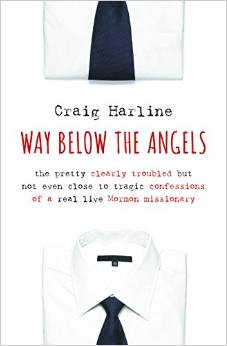
Way Below the Angels by Craig Harline

Way Below
Craig Harline, Way Below the Angels: The Pretty Clearly Troubled but Not Even Close to Tragic Confessions of a Real Live Mormon Missionary
This may be the most painful book I have ever read.

Which kind of painful, you ask? Well, it's a little hard to describe, but let's call it a tender, commiserative sort of a pain, stemming from Harline's ability to do something that we almost never see done: to illustrate the immense internal burdens that not-all-that-apocalyptic-when-you-really-think-about-it external circumstances can create.
Seriously: this is not a book about genocide, child abuse, starvation, or POW camps. It's a book about a middle-class American kid who went on a mission to Belgium in the 1970s with too-high expectations and had to figure out how to trudge through days filled with difficult companions, rain, and no baptisms. But I think it is the very banality of the external experience weighed against the crisis of the internal one that I found so compelling. After all, you can read an (excellent) book like Unbroken and think: that was amazing, and it has nothing to do with my life. But you read Way Below the Angels and think: this is me--a kicked-over anthill on the inside, even when things are really not all that bad on the outside. I haven't served a mission, but the internal struggles that Harline describes are an all-too-real reflection of the extreme angst that most people (most people, right? It isn't just me, right?) wrestle with internally. And until Mormons develop a mental casserole, mental priesthood blessing, and mental visiting teaching visit, the problem is that you are all alone in there when you face this kind of struggle.
Harline provides an unusual kind of balm in the form of an epically raw and genuine account of his mission. This isn't a tell-all expose (pretty much the worst sin a missionary commits in this book is writing a letter on a not-P day). This isn't, obviously, a missionary hagiography, either. Instead, it is real life, lived in the mundane middle. We get very few missionary narratives like this. Which is precisely why the young Elder Harline was able to begin his mission with such an absurdly optimistic expectation for what his mission would be like. (At the risk of thread-jacking my own post: this is the problem we have with a lot of rhetoric in Mormon culture. We only hear the glory stories from happy RMs, happy mothers, happy marriages, etc. We don't usually hear the hard stories, and so if it is hard for us, the difficulty is compounded by the fact that we think we are alone and must be doing something wrong.) Throughout the book, he describes immense (internal) struggles along with a scant, precious few rays of light that end up revealing an awful lot about God and, I think, ultimately make this a faith-promoting book. (Faith-promoting in the real world of real life. Not faith-promoting in the sense of perpetuating a faith-promoting-but-ultimately-unsustainable view of life.)
And he's funny, so that helps. When you can't get past the front matter without laughing, you suspect that he (and you) will be OK in the end. The book can be a little over-written, a little trying-too-hard-to-write-cleverly and be funny. But sometimes it is brilliant, like when he compares the examination of his motives to the public dissections in old Dutch paintings. And when he recounts personal inspiration that, fittingly, comes in the most mundane of ways. And the fact that, nearly forty years later, he still felt somewhat traumatized by his mission made me feel . . . less lame about the minor problems that I fret about today. The real battles in life (for some of us anyway) are huge, if small, and Harline's book is a welcome exploration of them.

Review copy provided by publisher.

 Cross-posted to Times and Seasons.


Wednesday, August 13, 2014

Life Below Stairs by Alison Maloney


The rational part of my brain recognizes that this book is simplistic and derivative. The rest of my brain enjoyed it, because I am still nursing an obsession with Edwardian England (that well pre-dates Downton Abbey, thankyouverymuch).

Tuesday, August 12, 2014

The House We Grew Up In by Lisa Jewell


Possibly the most dysfunctional family ever. Maybe the weirdest plot twists ever. But somehow, this worked for me. I actually liked it.

Review copy provided by publisher.

A Song for Issy Bradley by Carys Bray


How much did I like this book? So much that I do not regret the night of sleep that I lost to my inability to put it down. (That has literally never happened to me before. I always hate myself in the morning.)

Meet Bishop Bradley, the obediac. His wife Claire, who is not so much. His children, each with their own challenges. The character depiction and development is top-notch. The plot, in turns, hilarious and heartbreaking. The family's Mormonism doesn't just permeate every scene, but every line, every thought.  And every bit of Mormonism is here: our agony over our past and present, our faith and foibles, our cultural quirks and so much more.

The author's info announces that she has left the church and while your book group may have trouble with the one moderately graphic sex scene and f-bombs, I felt this was an ultimately faith- and culture-affirming book.

I'm not going to say much more about it, although there is so much to discuss here--from how polygamy impacts women's lives today, to how we balance church and family and obedience and autonomy, to how we deal with tragedy, to thinking about the inevitable dramas of marriage, to what we do to our young women, to how we think about miracles.

This one's a winner.

Review copy provided by publisher.


Big Little Lies by Liane Moriarty


I'm somewhat embarrassed by how much I liked this book. (But I really, really enjoyed it.)


Friday, August 08, 2014

Mark 1-8:26 by Robert Guelich


In some ways this is quite dated with its emphasis on form and source criticism, so I would not recommend it if it were going to be the only commentary one reads on Mark. But there are some interesting insights here--I found myself quoting him a fair bit--so there is some value in it as an additional source.

Thursday, August 07, 2014

Shopaholic and Baby by Sophie Kinsella


I wanted pure fluff, but this wasn't up to her usual standard.

Tuesday, August 05, 2014

When the World Was Young by Elizabeth Gaffney


I really liked this book. Excellent character development, interesting plot. Not perfect, but very good.

Review copy provided by publisher.

The Silent Wife by A. S. A. Harrison


So lame.

Friday, August 01, 2014

Wednesday, July 30, 2014

Mark as Story by Rhoads, Dewey, and Michie


An excellent introduction to the narrative criticism of Mark.

Tuesday, July 29, 2014

The Fortune Hunter by Daisy Goodwin


Reading this book was like reading Downton Abbey (although the book is set a bit earlier). In other words, it is an excellent light read:  a little history and a lot of romantic fluff.

Review copy provided by publisher.

Mark and Method ed. by Anderson and Moore


This is an excellent introduction to modern approaches to Mark and is mostly accessible to the lay reader.

Sunday, July 27, 2014

Thursday, July 24, 2014

The American Heiress by Daisy Goodwin


Like reading Downton Abbey.

Wednesday, July 16, 2014

Lost in Shangri-La by Mitchell Zuckoff


This was pretty good.

Elijah of Buxton by Christopher Paul Curtis


I read this to the boys. It was quite good.

Monday, July 14, 2014

Mark 1-8 by Joel Marcus


So if you are a long-time reader of this blog, you may have noticed that about a year ago, things changed around here. The number of books I read was cut roughly in half and I pretty much only read fluff.

Well, there's a reason for that: I started working on a big project and so my leisure reading was drastically cut back (to, basically, a few minutes before bed, doctors' waiting rooms, swimming pools, etc.). That big project involves reading about two dozen commentaries on the Gospel of Mark. This is the first review that's going up for those commentaries and I know you are dying of anticipation for the other ones, but it will probably be a few years: you're only getting this one now because it's one of the rare two-volume ones.

So: Of the roughly two dozen commentaries that I am reading on Mark, this one is in the top three because of his careful attention to literary issues, particularly resonances from the Hebrew Bible. I do detest the Anchor Bible format (it's redundant and redundant), but the content makes up for it.

Saturday, July 12, 2014

Rereading Job by Michael Austin


There is something new under the sun! Michael Austin's reading of Job is faithful and critical, learned and accessible, serious and witty. And while his primary focus is on literary concerns, he doesn't neglect the historical development of the book. Austin has not only cracked open Job, but he has also set a new gold standard for Mormon writings about scripture by seamlessly blending serious biblical studies, the Western literary tradition, theological reflection, and personal insight into one remarkably well-written book.

Review copy provided by publisher.

A Tangle of Knots by Lisa Graff


Possibly the oddest book I have ever read. 

Tuesday, July 08, 2014

The Confessions of Frances Godwin by Robert Hellenga


Great premise here, lots of interesting ideas, but this just didn't come together.

Review copy provided by publisher.

Tuesday, July 01, 2014

One Plus One by Jojo Moyes


I liked this. Yes, I am a complete sucker for Jojo Moyes. You want British chick lit, she's your man!

Review copy provided by publisher.

Blog Archive