 I'm feeling a little guilty for reading so much Witherington lately instead of getting a broader variety of sources, but I just like him so much. This is another great title.
Sunday, December 31, 2006
Conflict and Community in Corinth by Ben Witherington
I'm feeling a little guilty for reading so much Witherington lately instead of getting a broader variety of sources, but I just like him so much. This is another great title.
1-2 Corinthians by Craig Keener
 This was a little skimpy compared to the depth of commentary that I am used to. However, I've had people ask me for a good 'first commentary' and now I can recommend The New Cambridge Bible Commentary.
The Book Thief by Markus Zusak
 I've never fallen in love with a narrator's voice as quickly as I did this one--the fact that Death is the narrator probably tells you something about me. This was as excellent book--highly recommended.
Thursday, December 28, 2006
Blessing of a Skinned Knee by Wendy Mogel
 Mogel attempts to base child-rearing on Jewish principles. This serves as a useful corrective to our child-obsessed (but, paradoxically, child-neglecting) culture. But her execution leaves a lot to be desired. I often sensed that she said what she wanted to say and then mined 3000 years of Jewish tradition for a quote to support her viewpoint. She was also maddeningly vague: Yes, we all agree that kids need reasonable limits (who would argue with that?) but what precisely should those limits be?
Thursday, December 21, 2006
Hebrews: A Commentary by Luke Timothy Johnson
 I'll try not to let my general distaste for the epistles color my feelings toward this commentary: it was solid if not enrapturing.
Wednesday, December 20, 2006
The Ghost Map by Steven Johnson
 Ranking as one of the very best books I have read in a long time, Johnson makes the 1854 cholera epidemic in London fascinating. His wry humor, good storytelling, deft elucidation of the big issues, and great details make this one highly recommended.
Sunday, December 17, 2006
Reminiscences of an Octogenarian by Bruce Metzger
 Bruce Metzger is the main man of twentieth-century textual criticism of the Bible; this volume had a few interesting anecdotes in it, but was otherwise simultaneously too scanty and burdened with numbing detail.
Friday, December 15, 2006
The Letter of James (Anchor Bible) by Luke Timothy Johnson
 This was a pretty good commentary; definitely the best of the three that I read. My esteem for the ABC series increases, but I am still annoyed by their decision to cram references into the text instead of into notes.
James (Word Biblical Commentary) by Ralph Martin

I've tried to like the WBC series because people I respect like it, but I just don't like it.
The Epistle of James (NICNT) by James Adamson
 The NICNT is one of my favorite commentary series but this one wasn't that good, perhaps because it is so old--almost my age!
Wednesday, December 13, 2006

Saturday, December 09, 2006
The Best School Year Ever by Barbara Robinson
 I read this to the boys because it is the follow up to the absolutely delightful Best Christmas Pageant Ever. But this was lame.
Friday, December 08, 2006
Group: Six People in Search of a Life by Paul Solotaroff
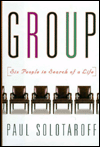 I never would have picked this up--I only own it because some doofus from half.com shipped the wrong book to me and then told me to keep it. I decided to give it a whirl before I got rid of it and . . . it was fabulous. The author played fly-on-the-wall for a year at a group therapy. The stories are fascinating. The best part, however, is the surprise twist at the end (which then changes the tenor the reader's impression of everything that came before) but I don't want to give it away . . .
Monday, December 04, 2006
Because of Winn-Dixie by Kate DiCamillo
 I read this out loud to the boys. They really enjoyed it but it didn't do much for me.
The Time Traveler's Wife by Audrey Niffenegger
 At first I thought that this book was going to do for time travel what Twilight did for vampires. But about half way through the story kind of sputtered and by the end I was just vaguely annoyed.
The Life and Times of the Thunderbolt Kid by Bill Bryson
 I normally like Bill Bryson quite a bit, but I think he shot himself in the foot by writing a book that is, to paraphrase, true except for the parts that aren't. It wasn't as funny this way--it was just mindless.